Grace Burton-Edwards & Brian Schwartz
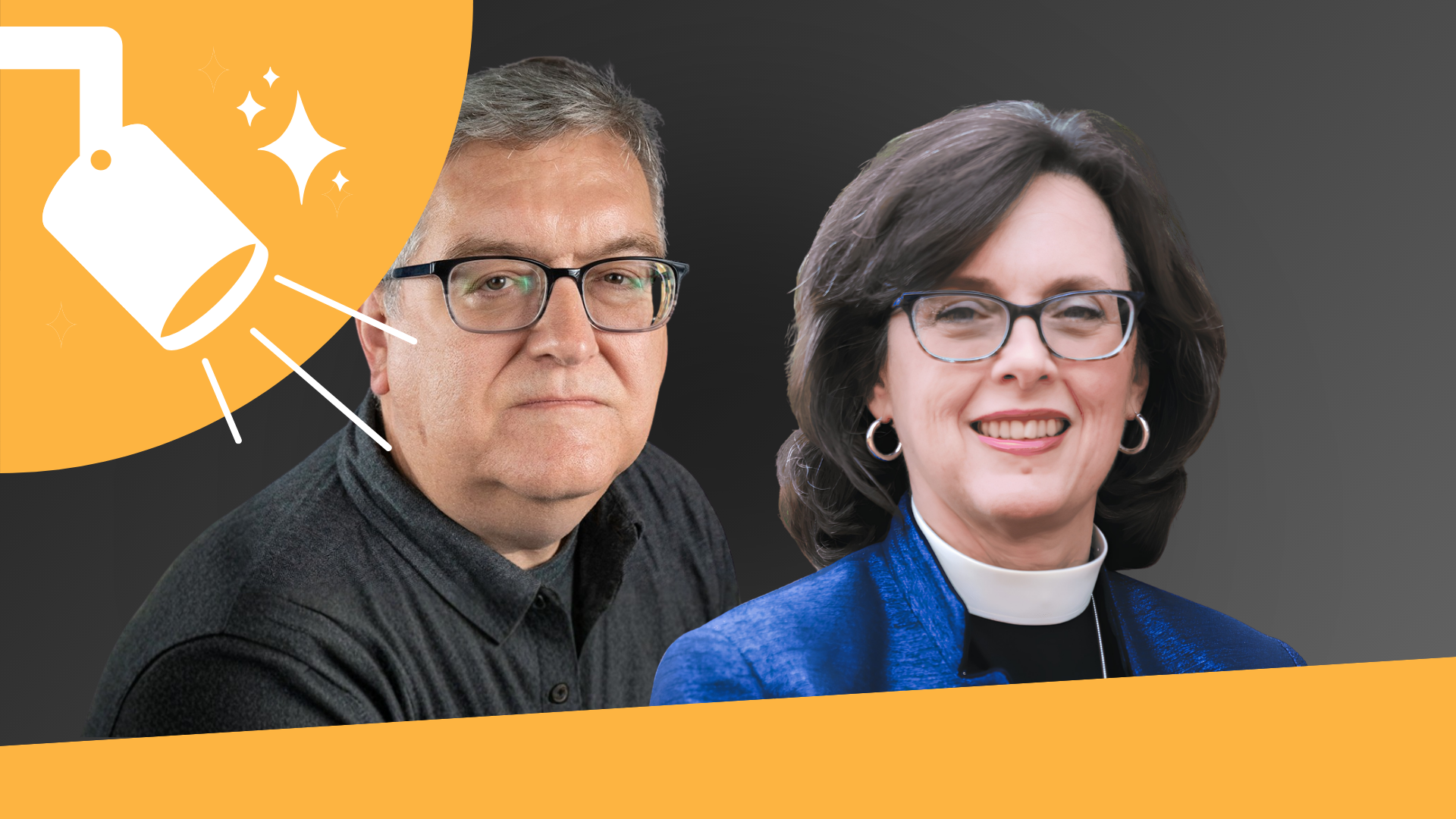
Gill chatted with Grace Burton-Edwards & Brian Schwartz to learn about their experiences within a church community that is intellectually curious, honest, and compassionate in its ministry, and deeply committed to the dignity of every person.
Introducing Brian & Grace
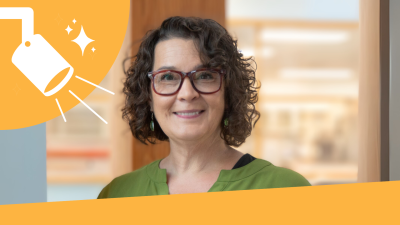
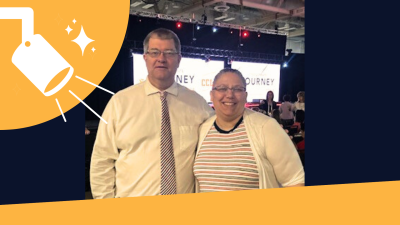
Brian Schwartz is a Professor of Biology at Columbus State University in Columbus, Georgia, where he has spent three decades teaching topics in biology, including genetics. He brings this expertise into his leadership at St. Thomas Episcopal Church. The Rev. Grace Burton‑Edwards is an Episcopal priest and rector (senior pastor) of St. Thomas, where she leads worship and adult formation in an inclusive, justice‑oriented community.
We first connected with Brian through a workshop with the Genomics Education Partnership (GEP). Familiar with our work and faith community programs, he proposed hosting a genetics series at St. Thomas Episcopal Church and introduced us to Rev. Grace Burton-Edwards. Grace welcomed PGED to integrate discussions about the impact of genetics into their congregation’s weekly programming, led by Rob O’Malley.
Gill: Tell us about yourselves and your work at St. Thomas.
Brian: I’ve been a biology professor at Columbus State University in Georgia for 30 years. My PhD is in genetics; I focus on genetics and developmental biology, and I also teach medical genetics and genomics, general biology, and a capstone on evolution. I started attending St. Thomas in late 2016 and have been part of the congregation since.
Grace: I’ve been an Episcopal priest since 2007 and rector (senior pastor) at St. Thomas since 2014. I love leading worship and preaching, but I’m especially passionate about adult formation, which our congregation strongly values. St. Thomas is known as an inclusive, open‑minded community that cares about justice. As an adult convert to the Episcopal Church, I’m deeply committed to our baptismal covenant—seeking Christ in all people, striving for justice, and respecting the dignity of every human being. I’m married to a Lutheran pastor who also works for the United Methodist denomination. While our adult children live elsewhere now, we love calling Columbus home.
Brian: We framed PGED’s genetics series around those baptismal promises: treating every person with dignity and striving for justice. I’m not a lifelong Episcopalian; I knew little about the church before visiting, but those values are what drew me in. Formally, I now serve on the Creation Care Team and maintain our native plant pollinator garden, which I love. I also serve on committees when needed.
Grace: Beyond that, Brian often helps lead worship, works with the youth group, mentors confirmation students, leads occasional series, has served on Vestry, and even chaired our search committee for the associate priest. We get to tap into his gifts quite a bit.
Gill: What is the “why” behind your chosen paths?
Brian: I fell in love with genetics in 10th‑grade biology, especially doing pedigrees, because they felt like puzzles. Learning about genetic engineering made it seem like a viable career, and by the time I realized it wasn’t as lucrative as I’d imagined, I was already committed. I knew early on that genetics would mean getting a PhD for the kind of job I wanted to have. Teaching came later; I always enjoyed it, but only realized it could be my career once I actually started doing it over 30 years ago. Now I love teaching, especially genetics. As for joining the church, I sought out St. Thomas during a political moment when I needed a church that was clearly welcoming and affirming of all people.
Grace: I got called into ministry when I was young, but I was in a denomination that didn’t affirm women in that role. Even after ordination, I kept finding myself in churches where intellectual inquiry and inclusive love hit a ceiling, where you had to watch what you said and who you welcomed. In my early 30s, I realized I couldn’t keep serving in that environment.
When I was in college, I spent a semester in London attending an Anglican church and fell in love with that kind of worship and spirituality. Eventually I understood that I needed to be an Episcopal Christian—ordained or not. I was able to step away, explore that call, and was ordained in the Diocese of Indianapolis before coming to St. Thomas. In the Episcopal Church, especially with its baptismal covenant, I found a community where I could actually live out what I believe Jesus taught and modeled. I feel privileged to serve in this way. I just knew I needed to be here.
Gill: What is one change you are trying to make in the world through your work?
Brian: As a teacher, I want people to know more about biology and genetics, the subjects I care about most. In the church, I want to live as my best self and help others do the same.
Grace: I want people to know they are “fearfully and wonderfully made”, deeply loved by God as they are, and invited into a life of ongoing transformation: growing deeper in love of God, neighbor, and self. Because the Christian message is often distorted in ways I don’t think are particularly Christ‑like, much of my work is reinterpreting faith for people, especially in the South, who grew up Christian but now struggle with what they were taught. Rather than discard everything, we ask: can we understand this differently? That’s why adult formation is central at St. Thomas. We help people revisit long‑held beliefs in ways that feel more just, free, and right. Many are rebuilding faith they don’t want to abandon; they’re looking for solid biblical and theological ground for what they’re coming to know is true. Our tradition offers that breadth. What we teach at St. Thomas and in the Episcopal Church isn’t invented from scratch; it draws from the deepest wells of our tradition. At the same time, we recognize that recent church history has harmed many. I’m grateful to serve in a place where we can relearn what it means to follow Jesus.
Gill: Is there a particular moment or experience you’ve had working with adults in your church that feels very special?
Grace: The turning point is different for everyone, and it often comes quietly. People may worship with us for a while and then one day say, “I’m ready to talk.” Sometimes it follows a crisis or big life change, but often it’s simply, “This tradition formed me, and I’d like to be formed in a new way.” Worship itself is very instructive; it permits people to be open to asking questions—especially if they come from traditions where questions weren’t welcome. Eventually, some are ready to sit down, share their story, and say, “I want to put this back together differently.” Those conversations are powerful. It’s a lot like puzzle‑solving in genetics. We have a rich “genetic heritage” of Christian tradition. Some parts are harmful and need to be let go; others have been lost or suppressed but can be incredibly helpful now. Creating space for people to explore that heritage freely is a gift.
Gill: The genetic connections are very interesting, and our team was honored to be invited to lead a workshop at St Thomas. How would you describe it?
Brian: I’d known of PGED and used some of the materials in my classes. After hearing more during a Genomics Education Partnership workshop, I suggested the idea when Grace gathered people to plan Christian formation. I saw that PGED had already worked with faith communities, so I felt confident on that side; I just wasn’t sure about interest levels. Grace and others were enthusiastic.
The genetics series wasn’t a typical workshop; it was a discussion‑based learning series that met weekly on Wednesday nights for several weeks. Rob O’Malley would present key scientific content, and then we’d have a conversation. Our congregation has many naturally curious people, and I suspected it might resonate, but I was still surprised to see 30–40 people show up each week. I’d thought 15 would be good—the room was full. It ended up being better attended than many sessions of our formation series.
Gill: Why invite a genetics conversation at church?
Grace: We sensed this was the right time for this type of conversation. Questions about race, identity, and heritage were very present, and trans rights, especially in athletics, were frequently in the news. We wanted to explore some of these issues at a biological as well as a social level. It felt like a chance for adults to “go back to science class” and ask questions they didn’t know to ask as teenagers. Many of us don’t get that kind of opportunity later in life.
My main concern was time: could we cover complex topics in about 50 minutes on Zoom and still have meaningful conversation? I wasn’t sure how quickly our parishioners would be able to get into “science mode”, since that’s not most people’s day-to-day. Rob did an excellent job presenting at a lay level with clear examples. The technology cooperated, the slides were great, and it worked better than I’d expected.
Gill: Anything that stuck with you or surprised you?
Grace: I hadn’t anticipated how central questions about disability would become. We’d recently invested in making our facility more accessible for people with disabilities, and the series opened deeper conversations about children and adults in our community with genetic differences. Having accurate scientific explanations about inheritance, mutations, and basic genetics allowed us to talk about faith and ethics in a more grounded way. It kept us from just speculating and made the conversations far more meaningful.
Brian: I remember several moments when people shared very personal experiences related to the topics. What we were talking about was important to them. It made it clear that this wasn’t just an abstract science discussion; it touched people’s lives directly. I hadn’t fully anticipated that degree of personal connection. It was both surprising and gratifying. I thought, “Oh wow, it was a good idea to have these conversations.”
Grace: Two other things stood out for me. First, although St. Thomas is fairly like‑minded overall, the series revealed a surprising range of views, especially around genetic testing. Some were comfortable with certain technologies; others were not. It was eye‑opening to see that diversity.
Second, one of the most powerful conversations focused on reproductive decisions for people with inheritable genetic differences. Special‑education teachers in the group shared stories about walking with families through puberty, sexuality, and the realities of pregnancy and parenting. The discussion was intense but respectful, with different, valid perspectives. Rob offered a powerful reframing: instead of only asking whether a particular couple could or should raise a child, he asked whether we were really looking at a failure of individuals or a failure of society’s willingness to provide compassionate support. He connected this to anthropological work suggesting Neanderthal communities cared for injured or disabled members. That shift from individual responsibility to communal responsibility was profound and has stayed with me.
Brian: Rob also used interactive surveys, which made clear just how varied our views were. People explained why they chose certain options, and even when we disagreed, there was a lot of, “I see why you’d answer that way.” It was a good reminder that we’re not always as uniform as we assume, and that we can still listen well to one another.
Gill: What is one quality you admire most in others?
Brian: Humility: the willingness to admit when you’re wrong and to apologize. It’s hard for most of us, but it makes everything so much easier.
Grace: Resilience. It’s like a muscle: it grows as it’s used. Sadly, that often means those who face the most suffering become the most resilient. But it’s rare that the “rubber band” actually breaks; most people stretch and get through. I often accompany people through very hard moments, and it’s remarkable what they discover they can handle with God, community, and often a strength they didn’t know they had.
Gill: When you were a kid, what did you imagine being when you grew up?
Brian: Before genetics, I wanted to be an eye doctor. I got glasses in fifth grade and was fascinated by the tools, the gadgets, and the idea of helping people see. It was my first serious, science‑oriented career idea.
Grace: In the culture I grew up in, women didn’t have many career aspirations. The goal was to be a wife and mother, and you went to college to become an educated wife and mother. Discovering a professional path in ministry was a complete surprise and a gift. I did eventually become both a pastor and a wife and mother, which has been wonderful.
Gill: Is there anything else you’d like to share?
Grace: Our mission statement at St. Thomas is: “Love God, love every person, learn and serve together”. This genetics series fits that mission beautifully. I’d highly recommend this kind of partnership to other churches. It was a rich experience for our congregation. If any communities ever want to ask what it was like, we’d be happy to talk with them and serve as a reference or resource.