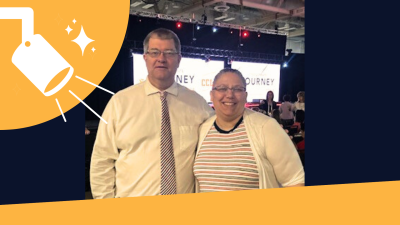
Dave Mangus

Gill chatted with Dave Mangus to learn about his professional mission to help students access STEM career opportunities they did not know existed. Dave strives to help students see the relevance of science in their lives.
Introducing Dave
Dave Mangus is the curriculum specialist for Worcester Public Schools (WPS). He coordinates science learning for students in grades K through 12. Dave also helps teachers navigate student learning throughout the entire school year.
Dave first connected with PGED as a workshop participant in Brockton, Massachusetts, which sparked a years-long educational partnership. Since then, together we have organized a multidisciplinary course for history and science teachers, teacher training in South Dakota, and are now hosting district-wide professional development for biology and biotechnology teachers at WPS. Our WPS workshops pair curriculum from PGED and Amanda Gruhl and Kathy Vandiver at the MIT Edgerton Center to create a highly engaging group of lessons that deepen students’ understanding of genetics.
Gill: Why did you decide to build a career in education?
Dave: Well, I’ve actually been involved with education my whole life. Growing up, my dad, who was a historian, gave presentations in my brother’s and my classrooms. Later, I completed my PhD at Indiana and moved to Worcester for a post-doctoral fellowship at UMass Medical School. My mentor there would also visit his kids’ classrooms to do science demonstrations. During my time at UMass as a research professor, I started doing this for my kids’ classrooms, too. The assistant principal eventually turned my classroom visits into school-wide events. The joy I found doing that encouraged me to leave the lab and move into a more formal, younger educational setting. I started my teaching career in Brockton, MA, as a biotechnology teacher. I worked there for 11 years.
Gill: What is one of the most meaningful projects you worked on during that time?
Dave: One of my passions is creating opportunities for students who might not otherwise have them. In Brockton, I created a four-year non-vocational biotech pathway based on my lived experience as a research scientist. To supplement that, we developed an after-school apprenticeship program, funded by the Mass Life Sciences Center. In that 12-week lab program, students cloned, expressed, and purified firefly luciferase. Our goal was for students to develop basic lab skills and model real biotech product development.
We had 3 pillars in the design of the pathway: 1. literacy, 2. hands-on science, and 3. social justice and understanding. We used PGED materials to contextualize the importance of understanding the broader implications of scientific advances. PGED helped our students understand why their learning was so important.
Gill: Why was this project so meaningful for you?
Dave: After completing the program, we helped students find summer internships to have authentic lab experiences. A lot of them went to the Dana Farber/Harvard Cancer Center, the Forsyth Institute, MassBiologics, and the Ragon Institute. Sponsoring labs often told us that our high school kids were indistinguishable from the college students they were working with. I am incredibly proud of the students for challenging themselves and for what they have accomplished. I am so glad this program is still going strong.
Gill: Your work balances hands-on science experiences with discourse-based learning. Why is this important in the biology classroom?
Dave: When I was teaching at Brockton, one of the first things that I did in my classroom was put up a motivational poster about collaboration. I wanted to center my classroom around the importance of working together, because the days when scientists worked alone in their laboratories are long gone. Collaboration is a 21st-century skill that our students need to develop, and discourse is the centerpiece. Also, there’s a lot of divisiveness in the world at the moment. If we can’t have civil conversations and argue from a place of evidence, then it’s really hard for us to move forward together in a purposeful way.
Ultimately, we are asking students to make sense of science phenomena, and verbal discourse is the foundation for their sense-making. That’s how those critical thinking skills develop and allow them to be independent, lifelong learners. For these reasons, discourse is now a huge focus here in Worcester Public Schools.
Gill: How do PGED materials help students engage in discourse?
Dave: Although PGED didn’t invent Four Corners, it’s an amazing activity that you have brought into your curriculum. It promotes student discourse and allows them to argue from evidence. If a teacher has created a safe classroom atmosphere where students can express their opinions, the conversations students have are amazing. It gives them a chance to discuss why they think the way they do about really complex topics.
Gill: What do you see as the biggest challenge in implementing new curricula in classrooms?
Dave: Helping teachers contextualize students’ learning, making sure that the students understand the value of why they’re learning about certain topics. Contextualization, in the absence of local phenomena or a clear explanation of the why, doesn’t push students or engage them as much as it could.
Gill: How do you think the PGED curriculum helps students understand the context around something they are learning in a lab?
Dave: The conversations we had during our recent professional development workshop about sickle cell disease (SCD) are a great example. It offers an opportunity to think about personalized medicine, cutting-edge ways to alter gene expression, and cures for patients. A lot of that work is going on right here in Massachusetts, and many people in our urban populations are affected by SCD. The phenomenon is personally relevant for our students, here in Worcester.
Gill: What do you like to do outside of work?
Dave: My love of science extends to my time outside of work. I like to garden and hike with my wife. We are also paddling enthusiasts–canoeing, kayaking–those are the types of activities I find most relaxing in my downtime.
Gill: What is one project you’re excited to be working on right now?
Dave: The City of Worcester’s Office of Sustainability and Resilience has asked us to design activities and units utilizing the local data they have. This is a fantastic opportunity to address the curricular challenges I mentioned earlier. I’m now collaborating with the City, the STEM Education Center at WPI, and a cohort of teachers to start that work. I believe this will turn into really robust learning experiences for our students over time.