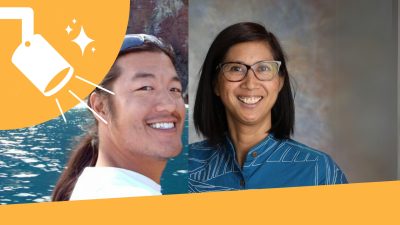
Richard Randolph

PGED’s Gill McNeil sat down with Richard Randolph to learn more about his work and dedication to promoting dialogue on science and spirituality.
Introducing Richard
Today we’ll get to know Richard Randolph who is Founder and Director of the Science and Spirituality Institute (SSI). Richard established the SSI to provide resources and opportunities for individuals and faith communities to develop their own, informed understanding of how science and spirituality relate to one another.
PGED first met Richard in 2019 during a visit to Lincoln, Nebraska where he was a pastor in the United Methodist Church. We enjoyed more opportunities to connect with Richard and collaborate through his radio show, Counterbalance, and the SSI’s 2024 launch event on “Genetics and Spirituality: Conversations at the Nexus of Science and Faith.” We are inspired by Richard’s passion for bringing conversations across science and spirituality outside of the ivory tower and making them accessible to everyone.
Gill: Tell me a bit about what you do.
Richard: I’m the Founder and Director of the Science and Spirituality Institute (SSI), which is a new nonprofit organized to promote greater dialogue, understanding, and appreciation between various sciences and diverse spiritualities. I spend a lot of my time networking and growing the SSI network.
Gill: What new projects are you working on right now?
Richard: I’m getting started with a podcast. I’m working on a couple of grant proposals. I’m also looking for opportunities to collaborate with different people and organizations. That’s what brought me to PGED – the opportunity to collaborate with Marnie on a conference that we did back in May.
Gill: Can you share a bit more about your journey to launching the Science & Spirituality Institute?
Richard: I’ve been interested in science since I was in the third or fourth grade. My parents encouraged my interest in science. At different times, they gave me a microscope and a telescope. I remember coming home from school on rainy days, getting water from mud puddles, and studying it under my microscope. And, I’ve always been interested in religion. My father was a United Methodist pastor. From college, I went to divinity school at Yale and ended up graduating with my M.Div. and a Master’s degree in International and Developmental Economics. After a few years serving as a pastor, I earned my PhD at the Graduate Theological Union in Berkeley. I was really interested in Berkeley’s Center for Theology and the Natural Sciences. When I arrived for my first semester, The Center’s Founder, a professor named Bob Russell, was offering a course that I really wanted to take. Unfortunately, the schedule conflicted with another course I needed to pass my comprehensive exams. I went to Bob and explained how interested I was in his course and that I hoped he would offer it again while I was still at Berkeley. He replied, “Why don’t we do it this semester as an independent study?” From there, we developed a very close relationship. Looking back, I see how he became my mentor in science and faith.
A couple of years later, Bob hired me to work full-time as the Program Director at the Center. In that position, I really grew in my understanding and appreciation for the mutually beneficial intersection between science and faith. I was able to be part of some awesome projects and meet some amazing people. I kept thinking to myself, that somebody should make all of this available to people who aren’t specialists. In other words, there should be science and spirituality resources for thoughtful people who are deeply interested in this intersection. I eventually got an invitation to join the faculty at Saint Paul School of Theology in Kansas City. From there I moved to the osteopathic medical school in Kansas City to help start a Master’s program in Bioethics.
Throughout this time, I kept looking for an organization that would provide excellent resources on science and spirituality for thoughtful laypersons. Although there are many good people working at this intersection of science and spirituality, no one was attempting to do exactly what I envisioned. Finally, I realized that this was something I needed to undertake. At this stage of my life, I want to promote a dialogue between science and faith or spiritualities. I’m now trying to position the Science and Spirituality Institute to fit this niche that desperately needs to be filled.
Gill: What are the key goals of the SSI?
Richard: We use dialogue to promote a greater understanding, appreciation, and learning between the sciences and different spiritualities. We also aim to tear down the stereotype that science and faith–or science and spirituality–must inevitably be in conflict with one another. One of our core values is radical inclusivity; which means everybody’s welcome at the table. All science perspectives are welcome. All spiritual perspectives are welcome. If you’re interested in promoting a dialogue, then you’re welcome.
Gill: You have a wonderful history of working with PGED. If you could accomplish one new thing or continue building on what you’ve already done, what would it be?
Richard: I’d like to do more conferences together. I believe that we need lots of conferences on genetics because it’s so important and it touches so many different parts of people’s lives: your meaning, your understanding of who you are as a person, medical treatments, and ethical questions raised by genetics. It cross-cuts a lot of different areas that I’m really interested in. I feel very privileged that I’ve been invited to be a part of PGED’s work and I think along with everybody else, I want to be at the very center of this very exciting mission that PGED has.
Gill: When you were a kid, what did you want to be when you grew up?
Richard: A farmer. My grandfather was a farmer and I spent a lot of summers working with him on his farm. I thought he had the coolest job because he got to drive tractors and he had all these animals. He had chickens, cows, and pigs. He was also a very special person. When I look back at who I’ve become, in many ways I embody his characteristics and his outlook on life, even though we’ve gone in completely different directions in our respective lives.
Gill: What is one thing that you would like to check off your bucket list?
Richard: I want to run in the Lincoln Marathon next spring. I was a distance runner in high school and college. During the pandemic, I was diagnosed with a condition called CIDP. My immune system was attacking the protective sheaths of the nerves going down my legs. When I walked, the muscles wouldn’t get the message to contract, so I would fall often. Eventually, I got to the point where I couldn’t move without a walker. I was diagnosed with CIDP the same month that a really good friend of mine was diagnosed with Lou Gehrig’s disease. He passed away several years ago. When I was dealing with CIDP, I felt lucky because it was just CIDP. I never thought that my life was in danger. I’ve since received very efficacious treatments and gotten better.
Last summer, my daughter and I went on the Camino de Santiago spiritual pilgrimage in Spain. That had been on my bucket list for some time. Well, I successfully completed the pilgrimage and earned my “Compostela,” which is the official certificate certifying that I completed the pilgrimage. I’m still not 100 % yet, but to be able to walk 72 miles in six days was an important accomplishment. And so what’s the next thing on my bucket list? Well, I’d like to run a marathon.
Gill: To push yourself to do these things after your diagnosis is really admirable. Thanks for sharing that. What else would you like to share with our audience?
Richard: Check out the Science & Spirituality Institute website and get on our mailing list. We are a start-up, so we welcome financial support through donations. You can give from the Support page. We are also very interested in what topics and questions our constituents would like to see us engage. So, look for the surveys that we will soon offer.
Your questions and interests are very important to me. I feel as though I’m on this great adventure with SSI, but I want to share this adventure and I desperately want to hear your ideas and suggestions for the future.