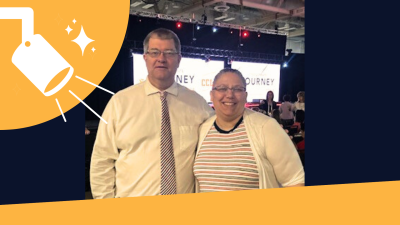
Dorothy Semenow

In this special Spotlight feature, Dorothy Semenow tells all about her past, present, and the exciting possibilities for her future projects.
Rather than a traditional interview, Dorothy opted to share her perspectives in writing. Through carefully writing and editing over many weeks, she produced an inspiring story about her life’s journey. We are honored to share her story with you.
Introducing Dorothy
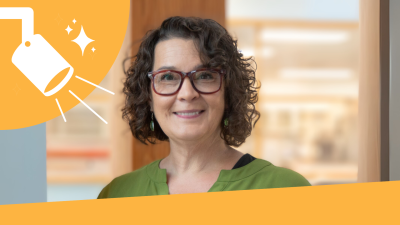
Dorothy Semenow is a 95-year-old chemist, psychologist, “edutainer”, and women’s rights activist, best known for becoming the first woman to earn a PhD from the California Institute of Technology. She has devoted her life to increasing science literacy, advocating for civil justice, and serving as a catalyst to help people improve their lives.
PGED is grateful for Dorothy’s fervent support of our educational programs and learning resources, and is excited to support Dorothy in announcing the launch of her newest resource, the CRISPR Whisperer Picture Series.
CHILDHOOD
Family: Biological & Chosen
I was born in Pittsburgh almost 96 years ago, about 5 months into the Great Depression. My parents separated before I was born – they never divorced, but never lived together again. My brother Joel, 3½ years my senior, became my dad’s stand-in, a role reinforced by Dad’s weekly visits: all attention on Joel, none on me. He was a relentless tease, except when he granted my pleas that he teach me what he was learning in school. What a teacher—fair, patient. Hours, days: no “Girls can’t do anything!” And Dad was a top teacher, too; Mom even said that neighborhood bankers raved about his evening courses at Pitt. The teaching gene runs in our family.
My good fortune began with Blessed Aunt Bess, who lived with us, and grew when the Breckenridges—an intact family with a mother, father, daughter Jean, and a crazy dog who never stopped barking at me—rented the garage next door. I was 2¼, Jean was 2½. We were inseparable for the next decade, always cooking up something to sell, perform, or rope the neighborhood kids into. I immediately embraced “The Brecks” as my “chosen” family. They were Gentile, we were Jewish. Add Jewish/Gentile to already well-entrenched girl/boy: therein lies the root of my drive to bridge the disparate loves in my life.
MY CAREER ADVENTURES
Mt. Holyoke College
I was a chemistry major at Mt. Holyoke College (MHC), where the extraordinary chemistry department consisted of four women—Emma Perry Carr, Mary L. Sherrill, Lucy W. Pickett, and Anna Jane Harrison—all married to chemistry, and one gentleman chemist—George Hall—married to a woman. In my senior year, John D. (Jack) Roberts, a rising young star at MIT, gave a series of chemistry lectures at MHC and was impressed by the teaching and research there. I was equally impressed with him and decided on the spot to pursue my doctorate under his direction at MIT.
MIT
Not long after I arrived, courting season began—when students jockeyed for spots in the labs of their chosen research directors. Catching Roberts in his lab on a Saturday, I told him my goal was to teach college chemistry; he boomed, “You mean, you have a burning desire to teach and nothing else?” “Well, teach—and research, of course!” I piped back. I was IN! Back in 1952, my lab was a quarter mile from the nearest women’s restroom—but at least the route was indoors all the way!
My course plan had to pass my faculty advisor, George Scatchard, a member of the old guard, threatened by the young upstart chemists like Roberts. He insisted I take MIT’s thermodynamics course, even though I’d already done every problem in the same text at MHC. Shrugging that off, he declared: “Mt. Holyoke is a good school and all that, but I think you’ll find MIT, well, hmmm… different.”
And my all-male classmates from big universities tried to psych me out before the big qualifying exams: “You mean you never had a course in advanced advanced organic synthesis?” Fortunately, my MHC mentors had prepared me: “Some of your classmates may know more than you—certainly all together will know more—but don’t let that do you in!” MHC taught me how to solve problems from first principles, which served me well. And when the unverified rumor spread that I’d topped the exam, those same rivals suddenly beat a path to my door for advice on their research projects.
I began mine that first year, but then Roberts left for a sabbatical at Caltech in his native California, where he was offered a full professorship—with the arrangement that his students could come along. All except me—Caltech didn’t accept women!
Women Banging on the Caltech Doors
Over the years, many highly qualified women working as technicians in Caltech labs had applied for admission and been routinely turned down. But my case was different: Future dual Nobelist (Chemistry & Peace) Linus Pauling, the Chemistry Division Chair, was very eager for Roberts to come to Caltech and wanted him happy with the move, so he was willing to spend some political capital to get me admitted; and Caltech faculty could relate to a student already doing graduate research—presumably contributing to her research director’s reputation.
The story of my admission, as handed down to me: My application wended its way through the Chemistry Division, Graduate Committee, Faculty Board, and Trustees. Then came the moment of truth: the all-faculty vote, requiring a two-thirds majority to admit me. A third supported me, a third swore “over my dead body,” and a third were undecided. Pauling laid it on: “Caltech has always stood against discrimination of every kind!” [an outright untruth!] “This [refusing me admission] is discrimination! Let us vote!” By God, he did it—he swung that middle third. Roberts’s good news telegram reached me at my home in Pittsburgh. “YOU RICHLY DESERVE THE HONOR, BUT I WILL NOT ENVY YOUR GOLDFISH BOWL!” Happiness was camping across the country with a friend, a fellow MHC alumna and former instructor of mine.
My Insulation at Caltech
arrived at Caltech, protected within the close-knit Roberts research group, somewhat isolated from the rest of the Chemistry Division. That was thanks to the bloody trail Roberts had left behind during his sabbatical at Caltech, when he’d mercilessly poked holes in research presentations by grad students and postdocs.
On top of that, Roberts had arranged for our group to make the hour-long commute to UCLA to join a chemistry group there for joint seminars, bypassing other Caltech chemistry groups entirely. They regarded us with awe—and surely anger, though that was never openly expressed.
My Minor and Dissertation Research at Caltech
At the time, biology—my preferred minor—ranked low in the science pecking order, far beneath physics, which Roberts pressured me to pursue instead. So off I went to consult Carl Anderson, the Nobelist Chair of the Physics Division, who looked me over and declared, “So, you’re the one who caused all the trouble, hmph?” I let out a nervous laugh and a weak, “Yes, I guess so.” I thought he was kidding, but later learned he’d been a diehard on the “over my dead body” contingent! I minored in biology! Meanwhile, Roberts had me take over his most far-out—and favorite—project, vacated by Howard Simmons, who had opted not to transfer from MIT. And by the end of my first year at Caltech, I’d done enough research to fill a dissertation.
More Sex Barriers: Within Caltech & Beyond
I heard there was an opening to teach the undergrad organic chemistry lab that fall, and I was excited at the prospect of finally scratching my itch to teach. But Roberts told me that was too much of a stretch, so soon after Caltech had just admitted its first woman. Rats. A harbinger of barriers to come. Caltech didn’t admit women undergraduate students until 17 years later, in 1970.
My main rival in our group, Doug Applequist, got the teaching job—even though he had less experience than I did—and soon after, backed by Roberts, landed a plum faculty job at a top university. My original goal, upon entering MIT—securing a faculty position at MHC—had shifted to such a post. And Roberts had gone all out to make that happen, arranging one-on-one time for me to discuss my research with each of the many leading university chemists who visited Caltech. And his efforts on my behalf never lagged—as I learned years later, while working on a project about top chemists, when he opened his files to me.
In his correspondence with R.B. Woodward, Harvard’s organic synthesis genius who died far too soon, I found a letter touting me for a faculty position at Harvard. He’d managed to stretch it to a second page showing only a single sentence—one that finally revealed I was a woman! Finally, Roberts’ November 20, 2016, New York Times obituary, written by Nicholas St. Fleur, stated: “In recent years, Dr. Roberts said that bringing Dr. Semenow with him to Caltech was ‘clearly the best thing I have done at Caltech in the 60 years I have been here.”
High Points at Caltech
Attending the course, “The Nature of the Chemical Bond,” taught by Linus Pauling, was a delight. He acknowledged my arrival with: “Good morning, boys…and girl!” The course title matched his 1939 book, which revolutionized the understanding of how atoms form molecules. But rather than use the printed book for reference, Pauling flipped through reams of what looked to be the original handwritten notes for the book, truly a sight to behold. Pauling’s passions weren’t limited to the intellectual. When it rained, all activities gave way to cooking and consuming the snails that crowded onto his garden wall.
Then, there was my jokey conversation with another charismatic Nobelist, Dick Feynman, held in a park—he riding a unicycle in small circles, me wobbling along on a bike. Whatever we said has been wiped from memory by the challenge of staying upright while laughing nonstop. While walking between buildings on campus, I felt a warm welcome from only two people, neither of whom I had any direct contact with: one was princely George Beadle, the Chair of the Biology Division; the other, visiting luminary, Robert Oppenheimer, often called “father of the atomic bomb,” who always tipped his pork pie hat at me.
My Main Legacy from Caltech
The final PhD oral exam is often a mix of jitters and joy. In my case, I felt especially honored to have Linus Pauling on my doctoral committee. But what’s stuck with me most isn’t that—it’s Caltech’s requirement at the time that every chemistry PhD candidate come prepared with 10 original research proposals, each ready to be launched in the lab. This story made the rounds while I was in grad school: Roger Adams was a towering figure in organic chemistry, with scores of research articles to his name. If you so much as glance at the table of contents of the Journal of the American Chemical Society—printed right on the cover—you would know roughly what he worked on. But even if you couldn’t answer such a question at your final oral, if you could defend your 10 propositions, you passed the exam! That emphasis—on inspiring you to do something creative with what you learned—is my most heartfelt dream for my team’s latest creation, The CRISPR Whisperer Picture Series. See Episode 02 for much more about that.
Moving On: A Lucky Landing
With a PhD in hand, my perspective broadened, the bloom was off my goal of a job at a major league research powerhouse, and I’d landed a mobile postdoctoral fellowship. So, after using it for a first year at UCLA, I switched to Pomona College, a small, excellent school where undergrads played an active role in research, a move that led to a faculty position in my second year there.
My colleagues—Nelson (Nellie) Smith, Corwin Hansch, and Freeman Allen—never showed sexism toward me. Indeed, they even included me in their practical jokes, the most memorable of which still makes me smile. In a play on words, they created a poster for a seminar I was to present. It read, “Has Dorothy’s halo been seen lately? We doubt it!” I jumped on the joke by showing up in a rented devil’s costume, complete with a swingable tail, I used to emphasize my presentation’s highlights.
The fun I was having with the guys—and the deep satisfaction I found working with students—began to outweigh my motivation to dig up the secrets of molecules. My old interest in psychology resurfaced. (As an undergrad at MHC, I’d completed pre-med requirements to keep the door open to a psychiatry career.) Fortunately, I was able to complete core courses in psychology while still teaching chemistry at Pomona, and then began exploring next steps in that field.
Psychology: Sharing Inner Lives & Focusing on Creativity
Huge hats-off to Lady Luck—and big thanks to U.S. taxpayers for funding my entire journey into psychology! David Rodgers, who oversaw postdoc admissions in psychology at UC Berkeley, had majored in chemical engineering as an undergrad. He saw a kindred spirit in me and invited me into the program.
Government fellowship money was a lot easier to come by then than it is now, and my PhD in chemistry turned out to be a golden ticket. I was on my way, except there was a hitch: a new California psychologist licensing law was in the works. Would a postdoc in psychology, completed by a Ph.D. chemist, qualify me to take the exam? The Licensing Board’s answer: “Try it and see!” Happily, my fellowship overseers—bless them—spontaneously offered to cover my tuition if I pursued the Psychology PhD that would fully qualify me. So I did.
That took me back to my old stomping grounds at the Claremont Colleges—this time as a graduate student at Claremont Graduate University. The Chair of the Psychology Department, eager to welcome a chemist into the fold, offered to accept my foreign language requirement as fulfilled during my Chemistry PhD. That was a real boon, because chemistry terminology in German closely resembles English, while psychology texts, not so much. I found the practice of psychology deeply satisfying—sharing the inner lives of a range of admirable individuals and helping them to unleash their creativity. (A deep wish of mine, as a child, had been to be Jean for a day.)
PIVOT TO SCIENCE EDUTAINER: FULL STEAM AHEAD
Board Games & Activities: DNA, Genomes, & Genetic Engineering
Then came the millennium, with predictions of change in the air. A decade earlier, at age 60, I’d sold my home in Southern California and moved to Bellingham, then a town of about 80,000, where I could live on less and work on whatever creative projects I chose. But where to begin?
The double-helix model of DNA, reported by Watson and Crick just months before I arrived at Caltech in 1953, had thrilled me. And I’d devoured Horace Freeland Judson’s The Eighth Day of Creation, a brilliant account of the molecular biology revolution, right when it came out in 1979. Now it was 2003. The Human Genome Project had just been completed; molecular biology was becoming a cornerstone of medicine, agriculture, forensics, and biotech. It was time for my “science genes” to turn back on! I’d create a board game about the path to modern molecular biology. It would star DNA.
I’d just finished the game mockup when Gregory Maguire came to visit. We’d become good friends during multiple residencies at Blue Mountain Center—a writers’, artists’, and activists’ colony in the Adirondacks. He was on a book tour—back before the Broadway production of Wicked catapulted him to fame and fortune—and he had an avid fan base in Bellingham. I thought he could illustrate his books better than the artists who’d been chosen. So, in a rush of inspiration, I added some draft illustrations to my “DNA Ahead Game & More” board game to help spark discussion. And just like that, my love affair with telling stories through pictures began!
“DNA Ahead Game & More,” a Monopoly-style board game—but with far more strategic possibilities—was published in 2017, and its use in classrooms was explored in workshops by more than 600 high school teachers. The game had gained CRISPR as a major feature when Emmanuelle Charpentier and Jennifer Doudna’s breakthrough use of the tool for genome editing appeared in print in 2012. After that, I couldn’t wait to star it in a board game of its own.
CRISPR Board Game Morphs into Picture Series
COVID, however, kiboshed those plans because I could no longer manage to playtest the game, so it morphed into The CRISPR Whisperer Picture Series—first 5 of its 15 episodes are now available for free download at CRISPRwhisperer.org.
Games & More Ahead?
My “do-something-with-what-you-learn” mission is still going strong—and dreaming up activities for it never ceases to delight me. Lately, I’ve been casting about for simple games and other hands-on activities where players can try on a future in which genetic engineering of all living beings—humans included—is possible.
A decade ago, when the first “International Summit on Human Gene Editing” took place, eminent science historian Daniel Kevles attended and published a perceptive—perhaps even prescient—article in Politico: “If You Could Design Your Baby’s Genes, Would You? We finally have the tools to achieve an old dream: better-quality humans. Will anyone stop us?” Now, that possibility is becoming real even faster than expected. As Kevles pointed out, “consumer demand and commercial interests may well drive the upgrading of human traits into everyday practice.” And for those who find the prospect unthinkable, history suggests otherwise: as with IVF (artificial insemination), once-repugnant biological innovations tend to eventually become commonplace.
All the more reason why activities like PGED’s “Share Your Stance on Personal Genetics” opinion-sharing card game matter—and why it’s so important that we help shape the guardrails, not just race past them.
If you are interested in helping to develop games or activities around these issues, please reach out: crisprwhisperer@gmail.com.