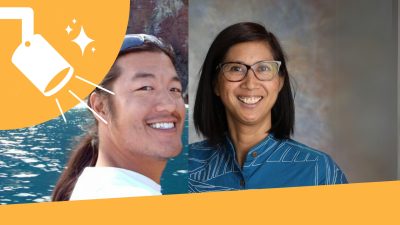
Christina Vallianatos

Gill chatted with Christina Vallianatos to learn more about her passion for creating learning resources and opportunities that spark an interest in genomics for students and teachers.
Introducing Christina
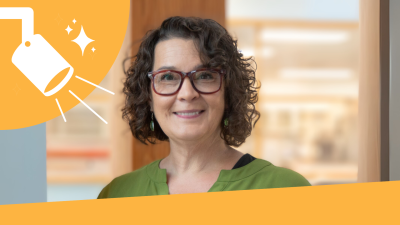
Christina Vallianatos is a Genomic Education and Outreach Program Manager in the department of genomic education at the Jackson Laboratory in Farmington, CT. PGED and Christina are long-time collaborators, working with the JAX Education team to deliver bioethics sessions for summer Teaching the Genome Generation teacher professional development workshops.
Gill: Tell me a bit about what you do.
Christina: My role at JAX is the best of both worlds for genetics education and outreach. I do curriculum development, like making lessons and activities or program management and design. I also create courses and lessons for different age learners, including high school teachers and students. I love the behind-the-scenes stuff, but I also love teaching courses, running programs, and managing activities in person with both students and teachers.
Gill: What projects spark the most joy for you?
Christina: Any project where I get to interact with students. I love seeing them learn and helping them along their learning journey. I also love working with teachers. We run a teacher professional development course in the summer through our TtGG program. Seeing teachers make connections between what they learn in our workshop and their classroom teaching is so special.
Gill: PGED is a huge fan of your TtGG program. Can you share a bit more about it?
Christina: A lot of teachers receive professional development in teaching and education principles, but there are fewer opportunities to gain professional development in science. That’s where we come in.
Teaching the Genome Generation (TtGG) is a teacher professional development program designed for teachers to learn a modern genetics curriculum and gain hands-on lab experience.
Our program gives teachers the latest and greatest in genetics and helps them bring it into their classrooms.
Gill: How does TtGG help teachers learn genetics and apply it to their teaching practice?
Christina: Our program takes a three-pronged approach to the curriculum: molecular labs, computational skills, and bioethics discussions with our wonderful collaborators at PGED. The molecular labs are genotyping labs where students isolate DNA from human saliva, amplify a gene of interest, and ultimately end up determining the genotype and exploring the genetic variation. We provide all the laboratory materials for New England area teachers, including the reagents, and loan out equipment at no cost. Once they’re finished, they give the materials back so another teacher can use them.
Gill: What other programs or opportunities are available to teachers?
Our team is constantly developing free lessons and workshops, which we host on our Genetics Learning Resources website. The biggest limitation with TtGG is that the in-person component is limited to New England. However, all of our TtGG curriculum is online and freely available. We have a free, online professional development program that is self-paced and grants teachers a certificate of completion at the end.
We also have a partnership with LabXchange to share our curriculum with a global audience. We are developing new virtual assets following the same pathway as the TtGG program: genotyping to explore human genetic variation from DNA extraction, PCR, gels, and genotype determination, all in a virtual setting with animations, lab simulations, and more. As long as you have a device and an internet connection, you can learn about human genetic variation and even practice lab skills!
Gill: Why are you passionate about genetics education and outreach?
Christina: In graduate school, I started studying a gene mutation affecting a local family with an intellectual disability syndrome. I was studying this mutation to understand how it could cause the family’s phenotype and symptoms. Through that, I got to meet more families that had the same condition. To this day, I still work with families living with the KDM5C condition. It opened a whole new world of human impact for me with my research.
It was a new experience to take information from the lab or my knowledge of genetics and have conversations with members of my community about it. That had a really big influence on me.
Gill: If you could work with PGED to accomplish one new thing, what would it be?
Christina: It would be great if we could help teachers better integrate the bioethics curriculum into their teaching so it’s more seamless rather than an add-on. Maybe it’s a bioethics confidence-building or skill-building workshop for teachers.
Gill: When you were a kid, what did you want to be when you grew up?
Christina: For a very long time, when I was a kid–and even an adult!–I didn’t know what I wanted to be. At some point, I remember wanting to be a veterinarian because I liked animals and helping. I’m not too far off from that, now. The theme of helping people is what drew me to science, and I still love animals!
Gill: Is there anything else that you would like to share with our audience?
Christina: When I talk to young people, I like to emphasize the power of being open to learning and to doing new things. Scientists know this well, that we are constantly building on our knowledge, reassessing, and learning new things. In life, opportunities come our way all the time. Our lives change, our interests change, new fields are created, and new types of jobs that didn’t exist before. Being open to change can help us learn and grow in ways we never imagined!