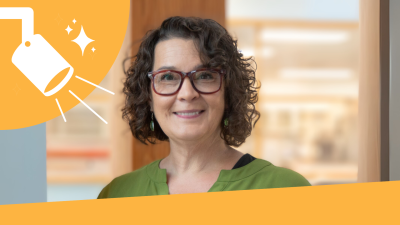
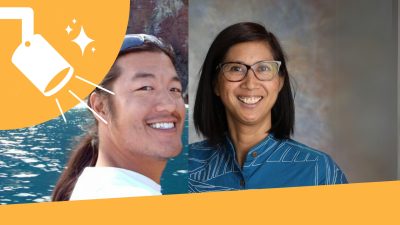
Fabienne Mondesir

Gill chatted with Fabienne Mondesir to learn more about her work as a science teacher in an alternative, public high school in Boston.
Introducing Fabienne
Fabienne Mondesir is a science teacher at the Boston Day and Evening Academy (BDEA), an alternative high school in Boston, Massachusetts.
Fabienne has been an active contributor to PGED’s community for years—first, as a participant in our early teacher workshops, then as a beloved PGED team member, and now as a science teacher at the BDEA. She is passionate about being a relatable role model and resource for her students. For Fabienne, finding innovative ways to engage and support them is a top priority.
Gill: Tell me a bit about yourself.
Fabienne: I’m a science teacher. I teach Genetics I and II at the Boston Day and Evening Academy (BDEA). BDEA is an alternative high school with a trauma-sensitive and supportive environment that serves students ages 16 to 23 who have struggled in other schools. This is my 20th year teaching in Boston public schools.
I’m also a mom. My daughter is 19 and in her sophomore year at the Fashion Institute of Technology in New York.
Gill: Why did you go into teaching?
Fabienne: I wanted to get young people passionate about biology and motivate them to pursue careers in the field. I’m a Haitian-American black woman in science. This is not something that a lot of my students have seen before. As their teacher, being someone they can relate to helps them envision the possibility of a future in STEM.
Gill: What is one project you’ve worked on that you’re especially proud of?
Fabienne: At BDEA, we do something called Project Month. Students pick a project based on their interests and work towards earning genetic content benchmarks to demonstrate their competency. This year, my co-teacher Nilo Ashraf and I called it ‘The Story of Our Genes’. The projects in this class focused on the personal and societal importance of DNA and its structure and function. We usually do some work with PGED lessons during this time.
Gill: During Project Month, Ting and Marnie brought PGED’s Share Your Stance on Personal Genetics card game to your class. How did your students feel about the experience?
Fabienne: Some students who struggle or are more apprehensive about traditional learning were clinging to this real-world discussion. It was all about sharing stories and being a human first. It sparked in my students in ways I hadn’t seen before. They were communicating with scientists, and their opinions were important and valued. They realized that their voice matters and people want to hear it.
I want more of that to happen in education. We should have real, authentic conversations about our personal and scientific experiences and how they make us feel. Doing this can create buy-in and a sense of community and intimacy. And, the students can ask questions and feel comfortable sharing their opinions and experiences in the classroom.
Gill: What do you think is the biggest challenge in your field today?
Fabienne: There are so many competing priorities. I’m constantly seeing different schools of thought for the best practices in teaching. It changes depending on your environment and who’s in front of you. What works for my students – some of who are dealing with concerns like homelessness or working a double shift before their nine o’clock class and falling asleep at their desks – is going to be very different from what works in other classrooms. I’m trying to learn and apply the best practices for my students.
Gill: What do you think is the biggest opportunity?
Fabienne: Technologies like AI and VR could change the future of the classroom. We could virtually delve into a cell to explore it and better understand how it works in the body, rather than just reading about it or doing a lab. The cell cycle might have seemed mundane to students, but once they see themselves as scientists solving a problem, they care about it. But, I also wonder how this kind of stimuli exposure might impact our brains long-term, and whether that’s safe for students.
Gill: If you could work with PGED to accomplish one new thing, what would it be?
Fabienne: I have students who come up to me after class asking for information about how to help their family members affected by genetic conditions. It would be great to have PGED as a science broker for the classroom – someone between the cutting-edge science and the people with questions. Maybe this would be a resource where students could ask questions on a message board and receive PGED’s answers. Or, a PGED summer camp where students learn PGED lessons and give feedback to the team!
Gill: When you were a kid, what did you want to be when you grew up?
Fabienne: I wanted to be a veterinarian. I wanted to be like a Black Jane Goodall! I liked primate research and zoology. I interned at Celtic Zoo for a bit working with capuchins and chimpanzees. It was wonderful.
Gill: What else would you like to share with our audience?
Fabienne: I’m thinking about how important it is to have time to reflect without a goal. I haven’t thought big about my teaching practice in quite some time because I’m so micro-laser-focused on what I need for my students now, tomorrow, and over the term. It’s hard, but taking the time to think about how to make something better for my students is something I want to do more and encourage other teachers to do as well.