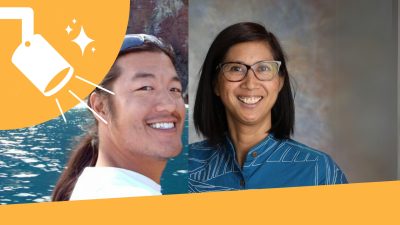
Alison & Dale Batie

Gill met with Alison & Dale Batie to learn how they bring personal genetics into their science and social studies classrooms in South Dakota.
Introducing Alison & Dale
For this Spotlight, we met up with Alison and Dale Batie. Alison is a science teacher and Dale is a social studies and instrumental music teacher at Eureka Public School in Eureka, South Dakota.
Alison and Dale met the PGED team at an educator professional development workshop hosted at Sanford Research in Sioux Falls, South Dakota in 2018. Dale attended to learn more about genetics and history, and Alison joined him as a curious science teacher. Since then, they have used PGED learning resources in their classrooms to teach their students about personal genetics and how it impacts our past, present, and future.
Gill: What does your workday usually look like?
Dale: I teach high school social studies and instrumental music for grades 5 through 12. This is my 27th year of teaching. On a typical day, I’m going back and forth between teaching music lessons, band, world geography, world history, American government, and this year, US history.
Alison: This is year 26 teaching for me. I teach grades 7 through 12 science during the day and then at night, we run a little business where we make and sell customized t-shirts and tumblers. When I started teaching I was in special education for four years. Then, I taught kindergarten and preschool for a year and eventually found a home in fifth and sixth grade for 15 years. Our school has about 150 students from pre-K through 12 all in one building.
Dale: We get to have connections with our students for a long time. I have had the same students for eight years, and Alison will have them for five, sometimes six. We get to see them grow. That’s one of the perks of small school life.
Gill: Alison, what kinds of content do you teach in your science classes?
Alison: My 7th and 8th graders are in integrated science, 9th grade is all physical science and 10th grade is biology 1. My juniors and seniors have the options of chemistry and biology 2 which is anatomy and physiology. That’s where I bring in most of my PGED materials. My biology students need to understand that there are different perspectives on science and life. They mainly get one perspective because of where they live, so I try to bring other perspectives into the classroom. For example, would their perspective on certain health treatments change if they had a child with a genetic condition?
Gill: It sounds like you are preparing your students well for some critical decisions they may face in their lives. What motivated you both to go into careers in education?
Dale: I had wonderful experiences in high school that led me to Northern State University where I got my music education degree. Two of my favorite classes that were not in my major were Introduction to World History and American Government. I loved both of the professors. They were probably two of the classes I had to work the hardest in, but it didn’t feel like work. It was fun.
Alison: I have a brother with Down syndrome, and growing up I was amazed with his special education teachers. I thought I would teach special ed for my entire career. Then, I realized that special ed students have lots of great special ed teachers, but they don’t always have an advocate in the regular ed classroom. I wanted to be that teacher for my students.
Gill: What’s one big opportunity in your work?
Dale: Our state has a teacher mentoring program. It’s great because you have someone who you relate to and can talk to… Our closest school is 23 miles away from us. We get to go to other schools and model how we do things and learn from each other. Our state keeps 20% more teachers in education after they go through the mentoring program.
Alison: We have a teacher shortage here in South Dakota. Because so many schools in South Dakota are small, you’re basically your whole department. If I was a brand new teacher coming out of college, it would be intimidating to be doing everything and not feel like I had somebody down the hall to talk to. So this [mentoring] program is really helpful.
Gill: If you could dream up a new PGED project for your classroom, what would it be?
Alison: A lot of my kids come from farming families, and I think they would like to know more about the genetic engineering of the crops that they’re growing.
Dale: I’d extend that to animals, too.
Alison: Yes. We are in an agricultural area. Our kids are doing artificial inseminations on the farm. They know what it means, but they don’t always have an understanding of why they’re doing it. I would like to understand it better myself so I can bring more information to my kids.
Gill: What’s one special project you’ve been working on?
Alison: Probably AB Creations, our small business. But, we didn’t mean for it to become a business at first. I just needed something to do outside of teaching and decided to buy a Cricut machine. I found out I was pretty good at making designs. I started making t-shirts for friends and family. Then, other people started asking me to make things for them.
Dale: It’s fun to see people wearing our shirts at volleyball games and basketball matches. We just got done making shirts for eight of the schools in our area for their all-state chorus and orchestra participants.
Gill: Do you have any words of advice or encouragement to share with our audience?
Alison: I would like to encourage educators to check out PGED’s lessons and use them. I’ve been using your resources for many years. The lessons have been dramatically eye-opening for my students.
Dale: I use the eugenics unit pretty much every year in my history class. It’s also eye-opening for my students because there are a lot of things in our history that they’re not aware of that they learn for the first time through this lesson.
Gill: Thank you both for your kind words and support for our resources. Let’s end on a fun note. What’s your favorite thing to do on the weekend?
Alison: It’s our kids’ activities. Right now, we’ve got one of our daughters playing volleyball. In a couple of months, it’ll be volleyball or basketball for two of them. Our oldest daughter is a cheerleader at Northern this year, where we are alumni. We love that we get to see her at our college doing something she loves.