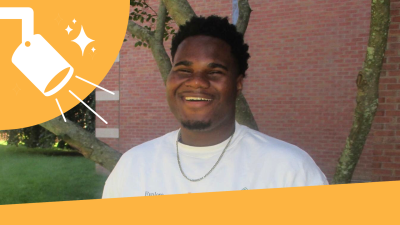
Michael Friend

Gill met with Michael Friend to learn about his work in patient advocacy and education for people living with genetic health conditions.
Introducing Michael
Today we’ll get to know Michael Friend, co-Founder of the Minority Coalition for Precision Medicine and Health Ministries Network. These organizations serve as a clearinghouse of healthcare initiatives to help mobilize faith-based communities.
PGED and Michael have been connected for nearly a decade. Michael and his close friend and co-Founder Shakir were building the MCPM when our teams joined forces through a connection made by the White House’s Office of Science and Technology Policy. Together, we have held community events in Baltimore and at Harvard, and participated in panels at CRISPRCon. PGED is inspired by Michael’s effort to change the lives of people living with genetic health conditions and honor the legacy of Shakir, who passed away from sickle cell disease.
Gill: What does your workday usually look like?
Michael: My days are built around engaging with community leaders to address the root causes of distrust in new and emerging technologies, particularly in minority communities. For example, I recently met with the deputy mayor in Baltimore to discuss CRISPR and how it can benefit underserved populations. I’m actively seeking opportunities in the Baltimore and DC areas to re-engage with CRISPRCon, where I serve on the Leadership Board. My goal is to reignite public discussions on CRISPR, building trust and understanding of its potential, especially among those who have historically been left out of the conversations.
Gill: How did you get started with this work?
Michael: I’ve had a lot of connections in my life to sickle cell disease. Shakir and my wife at the time had sickle cell disease. We attended a meeting with the National Sickle Cell Disease Association in Baltimore. After that meeting, I realized that a lot needed to be done to help sickle cell patients.
We later got an invitation to attend a meeting at the White House about precision medicine. We tried to get the White House to do an event around sickle cell disease, which wasn’t successful. But from the White House meeting, we co-founded the Minority Coalition for Precision Medicine (MCPM). We’re coming up on MCPM’s 10th anniversary.
The White House was where our connection with Harvard was made, out of the Office of Science and Technology Policy. It was with PGED that we began to launch our ideas, concepts, and plans, opening conversations and learning who needed to be in the room.
Gill: How would you describe the Minority Coalition for Precision Medicine?
Michael: I have always thought of it as a movement. What makes it a movement is the way we move. We have a rhythm. And, I’m launching a project called the Algorhythms of Justice initiative.
This project takes a deep look at the healthcare system and the way algorithms have been used to perpetuate bias. By drawing connections between the historical exploitation of Black culture—particularly music—and the ways healthcare tools marginalize Black communities today, we’re fighting to restore the “rhythm” of justice. This campaign is about confronting the systemic biases that have led to inequalities in both cultural spaces and life-saving healthcare. By realigning healthcare to serve everyone equitably, we hope to spark widespread change that addresses these deep-seated issues.
Gill: If you could accomplish one new thing or continue building on what you’ve done with PGED in the past, what would it be?
Michael: If I could build on the work already done, it would be to hold more Congressional hearings. There’s a tremendous need to spotlight the systemic inequities in healthcare, particularly as they relate to genetic innovation and the biases embedded in algorithms. I believe PGED can help elevate these discussions to the national level, advocating for policy changes that can lead to more equitable outcomes. Together, we can push for greater accountability and ensure that healthcare technology benefits all communities equally.
Another idea is to create a ‘Next Generation CRISPR Career Guide’ for students. There’s a need to connect young people—especially from underserved communities—with emerging opportunities in genetic technology. CRISPR is revolutionizing medicine, agriculture, and biotechnology. I want the next generation, particularly Black and minority students, to have access to the resources and knowledge necessary to explore careers in these areas. There is a hunger for more information. I want to inspire students to not only dream of working in these fields but to give them the tools, mentorship, and educational pathways to get there. We have appointed Skai Ryan Hack as the national Ambassador for the Next Generation CRISPR Project. She led the summer deep dives on CRISPR and played a crucial role in developing the Career Guide. Through her ambassadorship, we will reach individuals who might otherwise never learn about career opportunities in CRISPR. I’d also like to host an event at Harvard to celebrate the 10th anniversary of MCPM in honor of Shakir.
Gill: Shakir’s legacy lives on in your work. Is there a particular idea of his that has stuck with you?
Michael: He had an incredible ability to connect with others, whether in personal interactions or on larger platforms. If there was ever an opportunity for us to visit places like the White House, and they could only accommodate one person, I would always send Shakir because of the way he could communicate important issues as a patient. Beyond this, Shakir was deeply interested in collaborating with Hollywood to amplify awareness of scientific and patient advocacy issues, much like the event we participated in with the National Academy of Sciences and Entertainment Exchange. Because of Shakir, I remain committed to patient advocacy, and his vision for leveraging the entertainment industry to tell these stories is something I hope to continue.
Gill: When you were a kid, what did you want to be when you grew up?
Michael: As a kid, I wanted to be in entertainment. I had visions of being on stage, part of a creative world. But as you can see, my path shifted towards activism. What I’ve come to realize is that activism requires a different type of creativity—it’s about designing solutions to complex problems and envisioning a future that looks very different from today. So, while I didn’t pursue entertainment directly, the storytelling and engagement elements of activism allow me to channel that creative energy into causes I’m passionate about.
Gill: What is one thing that you would like to check off your bucket list?
Michael: Seeing the work that Shakir helped to advance come to fruition. Shakir was deeply involved in pushing the conversation around sickle cell treatments and genetic technologies like CRISPR. I’d love to see an accessible cure for sickle cell disease available, particularly in Black communities, using the technologies that Shakir and I were so passionate about. Whether through continued advocacy with organizations like the Innovative Genomics Institute or advanced discussions around equity in CRISPR, I want to ensure that Shakir’s legacy lives on by curing this disease that disproportionately affects our communities.
Gill: What else would you like to share with our audience?
Michael: In collaboration with the Bayha Group, we are currently conducting Summer Deep Dives that engage high school students through virtual learning experiences and paid apprenticeship programs. These initiatives connect students with professionals in genomics and biotechnology, empowering them to gain practical experience and insights from those already working in the field. By fostering these connections, we aim to guide students in their career paths and inspire them to explore new possibilities within the rapidly evolving landscape of genetic technology.