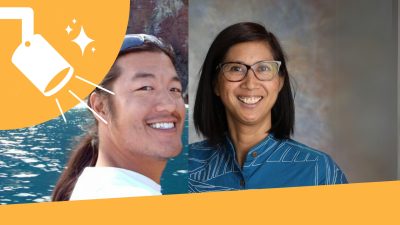
Roshni Patel & Alvina Adimoelja
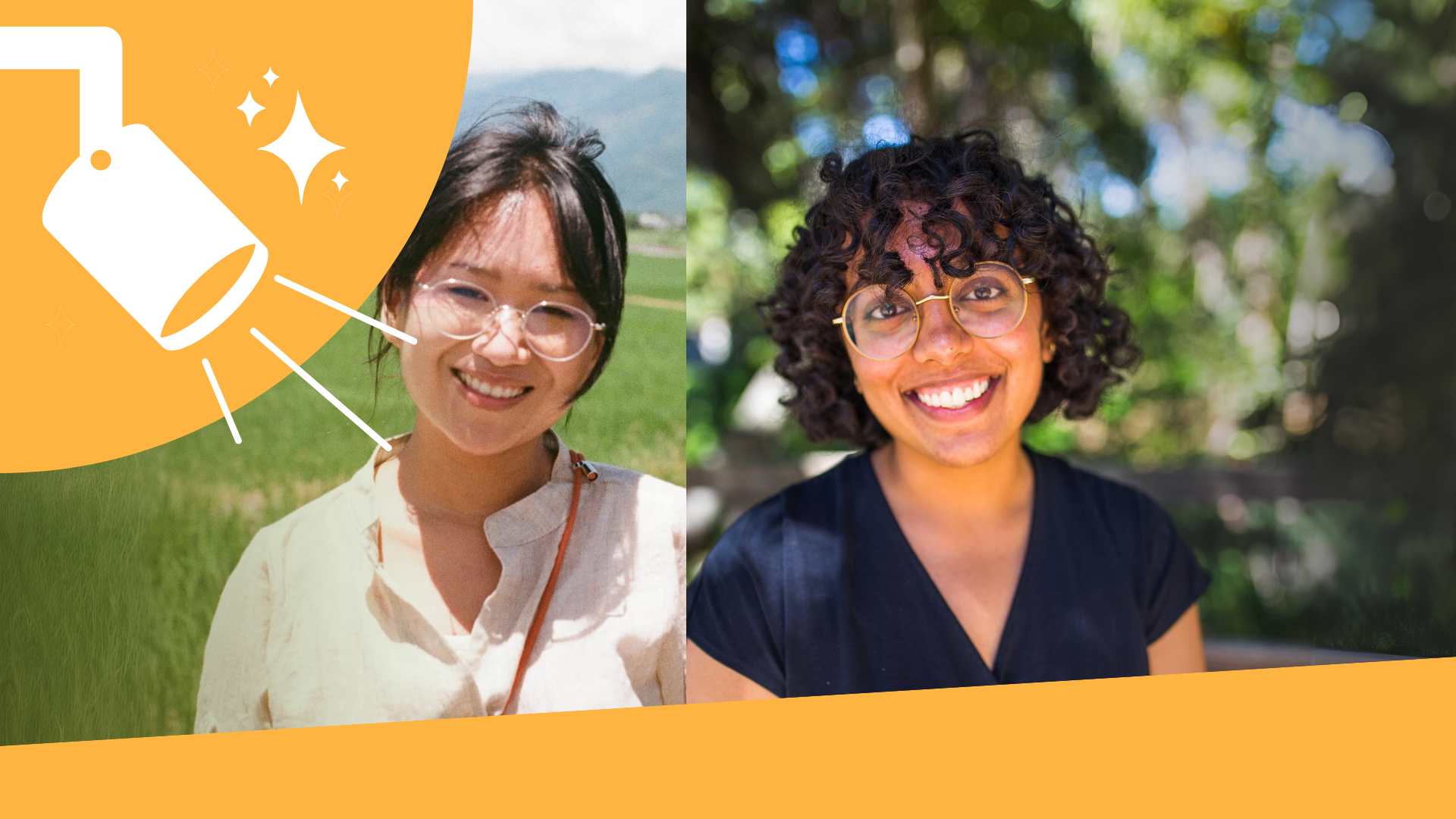
Gill joined Roshni Patel and Alvina Adimoelja to learn more about their proudest projects – including creating an Introduction to Genetics, Ethics, and Society college course.
Introducing Roshni & Alvina
Today we’ll get to know Roshni Patel and Alvina Adimoelja. Roshni is a post-doctoral fellow in the Department of Genetics at the University of Southern California (USC). Alvina is a fourth-year PhD student in the Department of Genetics at Stanford University.
While a graduate student at Stanford, Roshni met and connected with PGED over several programs and workshops. Since then, Roshni has co-created and taught a genetics and society course at Stanford. Alvina was first a student and is now an instructor for the course.
Gill: Tell me a bit about what you do.
Roshni: I’m doing research right now and hoping to get back into teaching soon. My research is in population and statistical genetics. I aim to understand the genetic basis of complex traits – traits like height, heart disease, or asthma, that are influenced by thousands of variants in the human genome – and how these traits have evolved over time.
Alvina: I also mostly do research and will be teaching a class in the spring. My research focus is on cancer evolution. I’m trying to understand the genetic mechanisms underlying the development of cancer and see to what extent we can predict it and use that information to improve patient experience or treatment.
Gill: What inspires you to do this kind of work?
Alvina: Complex traits are so fundamental to biology. I wanted my work on complex traits to contribute to clinical outcomes, even though my work is closer to basic science than clinical research.
Roshni: I like learning things and being a curious person. Research is one of those jobs that allows you to be curious forever. And, I’ve always been mathematically oriented. I wanted to use that interest in a way that I could learn about the world.
Gill: What’s one project that you’re especially proud of?
Roshni: The thing that I’ve been most proud of is creating the Introduction to Genetics, Ethics, and Society class. Rachel Ungar, my classmate at the time who is now a postdoc at the Stanford Center for Biomedical Ethics, and I started it together with a lot of help from other trainees, but we didn’t have any faculty advisors. It was an independent project that started as an effort by grad students and postdocs, which is just so special.
Gill: Tell me more about the course.
Roshni: Rachel and I realized that there was a clear gap in the education that graduate trainees at Stanford were receiving in terms of topics related to the ethical, legal, and social implications (ELSI) of human genetics research. We decided that this was a gap that needed to be filled and thought to design a course. We first offered it in 2022. It was a three-week pilot to see if our trainee-led model would work. Our goal was to give people the tools to discuss genetics ELSI issues in an informed way. The pilot went well, and the next year we expanded it into a three-month-long course.
Alvina: My experience of the class was first as a student during the pilot that Roshni mentioned. I was grateful that a group of students came together to create it because it’s not required, but needed. The model worked really well.
Gill: How would you describe the course’s content?
Alvina: Generally, it focuses on the societal implications of human genetics research. There have been some updates since it started in 2022. Roshni and Rachel developed the mini-course into a quarter-long format in 2023. Now, Tami Gjorgjieva, a classmate of mine and a fellow class instructor, and I restructured and further developed the class into three parts. The goal of the first part is to give students some background knowledge so they can discuss ELSI topics in genetics in an informed way throughout the course. We give an introduction to genetics and bioethics. Then, we move into the history of eugenics and bring in a faculty member from the Anthropology Department to talk about race and ethnicity. The second part of the course is about the ethical and societal implications of genetics research. The third part explores what happens when research is taken out of the lab and applied to society. For example, putting apps on the market for behavioral genetics and consumer ancestry testing.
We also have a group project where students come together to identify and create solutions for an ELSI problem of their choosing. The purpose of the project is to encourage students to recognize that the problems within the genetics community are our problems, too, and that they can develop innovative and effective solutions.
Gill: Our team learned about your course because you used PGED materials to develop some of the content. What other ideas do you have for working with PGED?
Roshni: I think what PGED does is so cool. We adapted a bunch of PGED learning resources for the course. It would be great to collaborate with PGED on a college-level education project. Students of all levels should have the opportunity to learn about society and genetics.
Gill: What do you see as the biggest challenge in the field of genetics? What’s the biggest opportunity?
Alvina: Genetics is becoming more mainstream because of commercialization. And because of that, it’s challenging to interpret the volumes of data that we have. But, not every field has the opportunity to explore broad questions that we can because we have so much data from people. We also have a responsibility to explore the data and ask questions meaningfully.
Roshni: Genetic data is finally diversifying in terms of race, ethnicity, and ancestry. And, this means we have to reckon with this new diversification. On the technical side, that means building better statistical models that don’t assume you have one big homogenous population. Models of human complex traits need to acknowledge and account for the different social environments and lived experiences across groups. It also means that we have to ask ourselves what it means to be working with diverse data sets. Having diverse data means we are now including marginalized groups that have historically been excluded from or exploited by scientific research. We therefore have an extra responsibility to consider the impact that our research has on society.
Gill: What is one thing that you would like to check off your bucket list?
Alvina: I want to go to every national park in California. I’ve been to Joshua Tree and the Redwoods so far.
Roshni: I would like to bike from San Francisco to LA along the Pacific Coast highway. I feel like biking is the perfect pace at which to appreciate the outdoors.
Gill: What else would you like to share with our audience?
Roshni: We published an article about our experience developing the course.
Alvina: We’d also like to share the class website, which includes the curriculum. We would love to have a version of this class in other institutions. We hope that the class will be a good resource for other trainees or faculty and staff who want to have similar courses in their institutions.
Roshni: We are happy to talk to people if they’re interested in using or adapting the course and need advice or strategies for getting this course or a similar one set up in their institutions.
To get in touch with Roshni, email roshni.achal.p@gmail.com.