What Does the Card Deck Include?
- 25 discussion cards across 5 categories. Each discussion card contains a ‘Big Idea’ statement and a ‘What If…’ question.
- 15 challenge cards that offer an action, question, or idea to consider with a discussion card.
- 2 rule cards for reference during gameplay.





Privacy
I would want to know if someone I was seriously dating had a strong predisposition for a genetic condition.
Examples of Reasons to Agree
- Because some genetic conditions can be passed down to children, and I know I want to have biological children, I would want to know what the risk could be to our future kids.
- Some genetic conditions affect people as they grow older, so I would want to know if there’s something I’d need to do to care for my partner in the future.
- If there was something I could do to help or better support them right now, I would want to know.
Examples of Reasons to Disagree
- That’s their private health information. I don’t need to know that.
- Unless we’re getting married or having children, I wouldn’t expect someone I was dating to disclose this information.
- It would just make me worried for them. I would focus more on their health than our relationship.
- I don’t think genetic information should impact the way I feel toward someone I’m dating.
What if you were the one with the genetic predisposition?
A person’s perspective on this topic might change if they imagine themselves as the one with the genetic predisposition. It can feel different to be viewed as the one “affected” by something they likely cannot change. Responses to this question may also differ depending on the perceived life impact of the genetic condition. This might impact their views about the privacy of the information, or how and when they might choose to share personal genetic information with a dating partner.
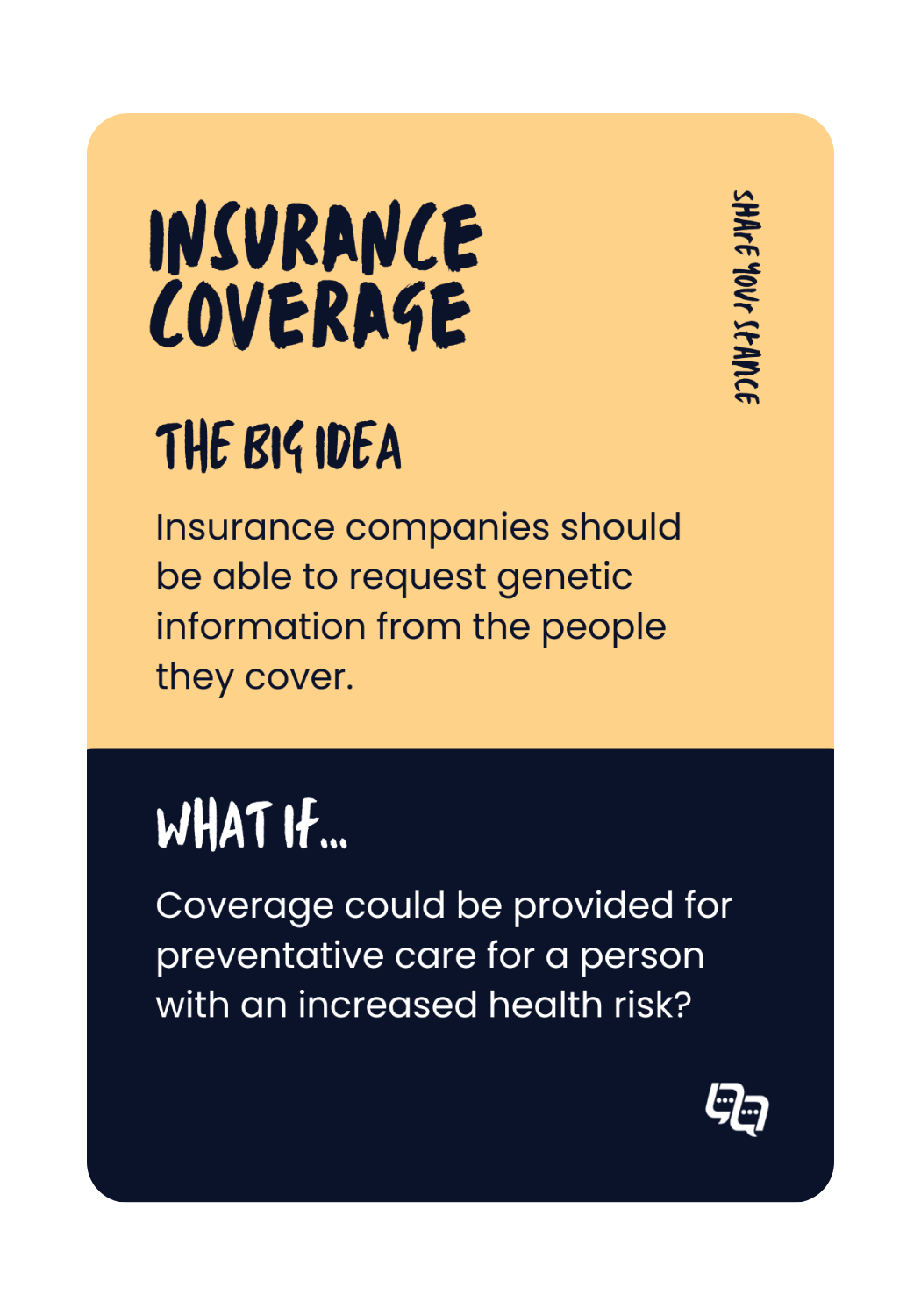
Insurance companies should be able to request genetic information from the people they cover.
Examples of Reasons to Agree
- There might be plans that are better suited to people with specific types of genetic predispositions or conditions.
Examples of Reasons to Disagree
- The information could be used to raise premiums, making healthcare far less affordable than it already is for many people.
- I want to keep my genetic information private. I worry that other companies might gain access to my data somehow.
What if coverage could be provided for preventative care for a person with an increased health risk?
This question is typically met with a resounding “disagree”. However, some employers are beginning to offer genetic testing and genetic healthcare services as health benefits for their employees. This would decrease the cost of genetic services, which can be expensive and inaccessible for many people.
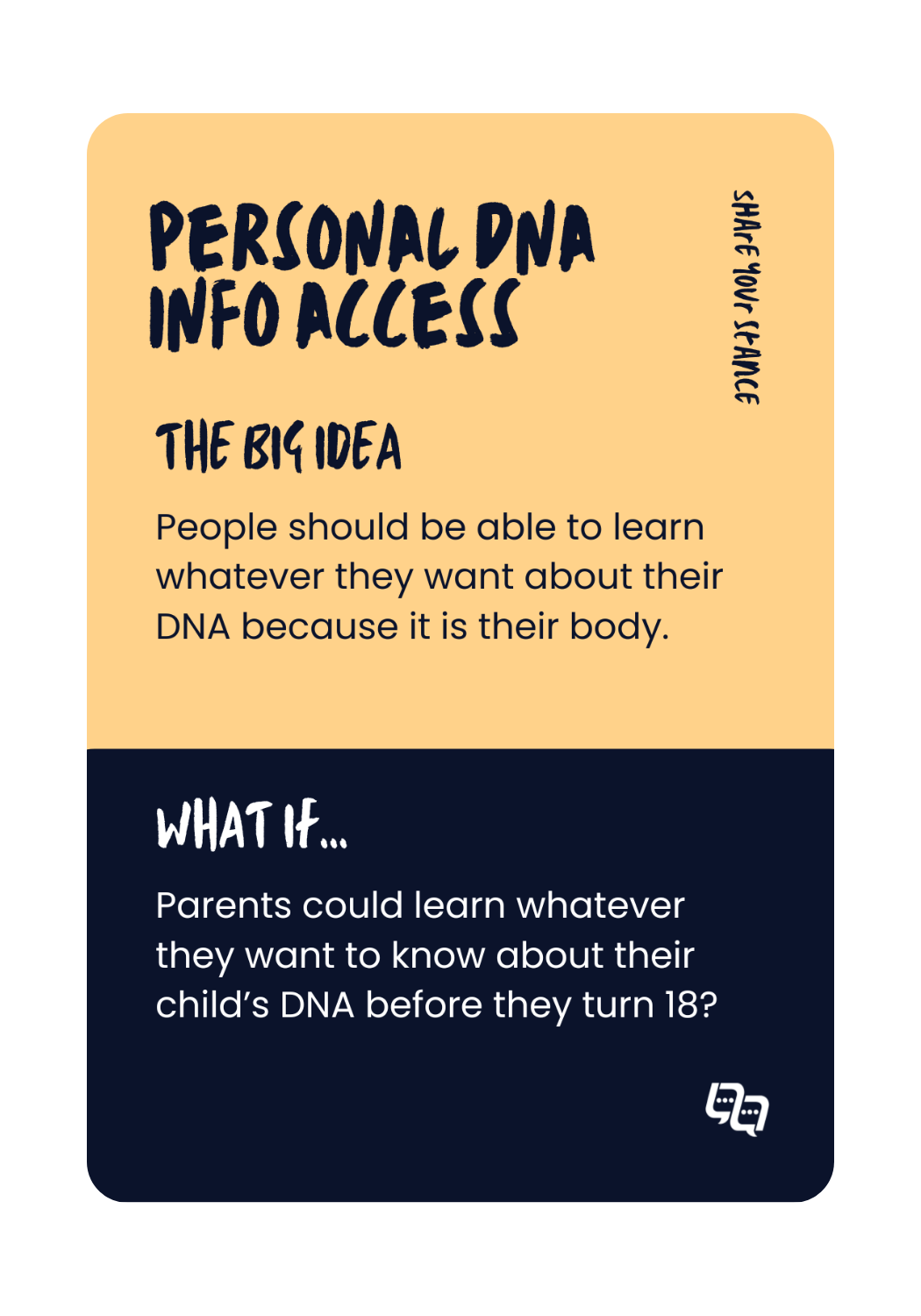
People should be able to learn whatever they want about their DNA because it is their body.
Examples of Reasons to Agree
- People should have the autonomy and right to choose if, how, and when they learn about their genetic information.
- Not all doctors routinely order genetic testing. Sometimes, the consumer knows what is most helpful for them. By taking an at-home DNA test, I learned I had a genetic predisposition for a disorder.
- I can handle whatever I learn from genetic testing, whether it’s positive results or negative.
Examples of Reasons to Disagree
- Sometimes, because of the emotional or medical implications, genetic information is difficult to learn – even if a person feels they’re mentally prepared.
- A person seeking genetic information probably has questions that can be best answered by a genetic healthcare professional.
- People should only be able to learn what’s medically relevant to them, or things they can take medical action to address.
- People learn about their DNA in different ways, either through a clinical test ordered by a healthcare professional or by doing an at-home DNA test. Some of those tests are inaccurate or take advantage of people’s lack of knowledge about genetics.
What if parents could learn whatever they want to know about their child’s DNA before they turn 18?
Parents who have access to their child’s genetic information might choose to share relevant information about their health during their adolescence or once they mature. Some parents might decide to never share the information unless their child asks directly for it. They might feel that their child isn’t ready to learn about their health risks, or a parent might not feel prepared to answer questions that may come up. On the other hand, some parents might share this information earlier in their child’s life, especially if they learn that their child will develop health challenges as they age.
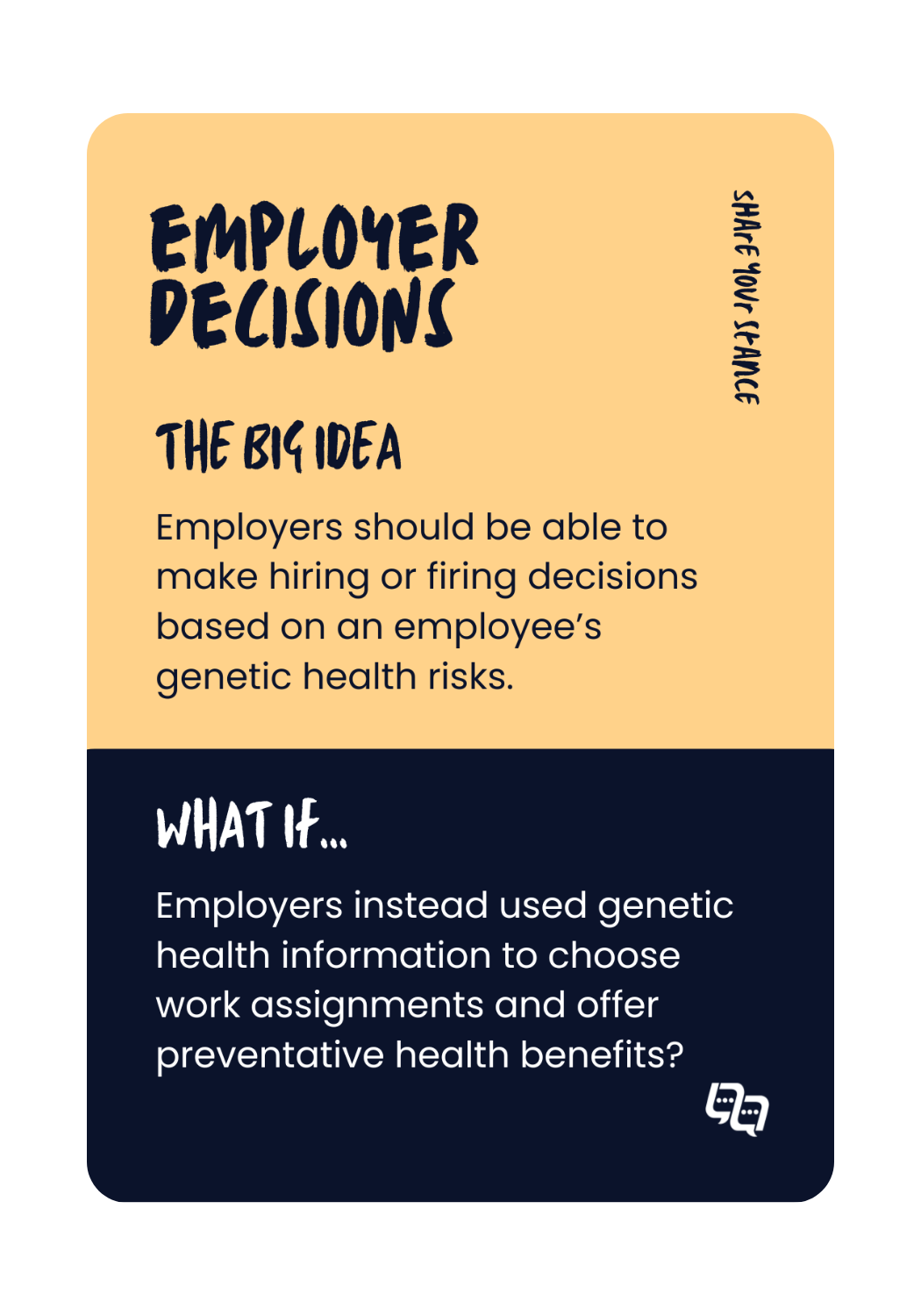
Employers should be able to make hiring or firing decisions based on a candidate or employee’s genetic health risks.
Examples of Reasons to Agree
- In certain cases, such as with military or aircraft pilot positions, the job requires particular physical aptitudes such as 20/20 vision. This might also apply to people who have a high genetic risk of developing a vision-changing condition during their lifetime.
Examples of Reasons to Disagree
- Employers should not be able to discriminate against candidates based on their genetic information.
- Genetic health information is private to each individual and should not be shared with anyone, let alone a potential employer.
What if employers instead used genetic health information to choose work assignments and offer preventative health benefits?
Responses to this statement might primarily disagree because of the US Genetic Information Non-discrimination Act (GINA), a policy passed in 2008 that prevents employers and health insurers from discriminating against people based on their genetic information. However, employers across the US are starting to offer genetic health benefits to their employees, such as testing and screenings. Whether this will lead to employers accessing the information to choose work assignments or offer preventative health benefits is undetermined (in 2025).
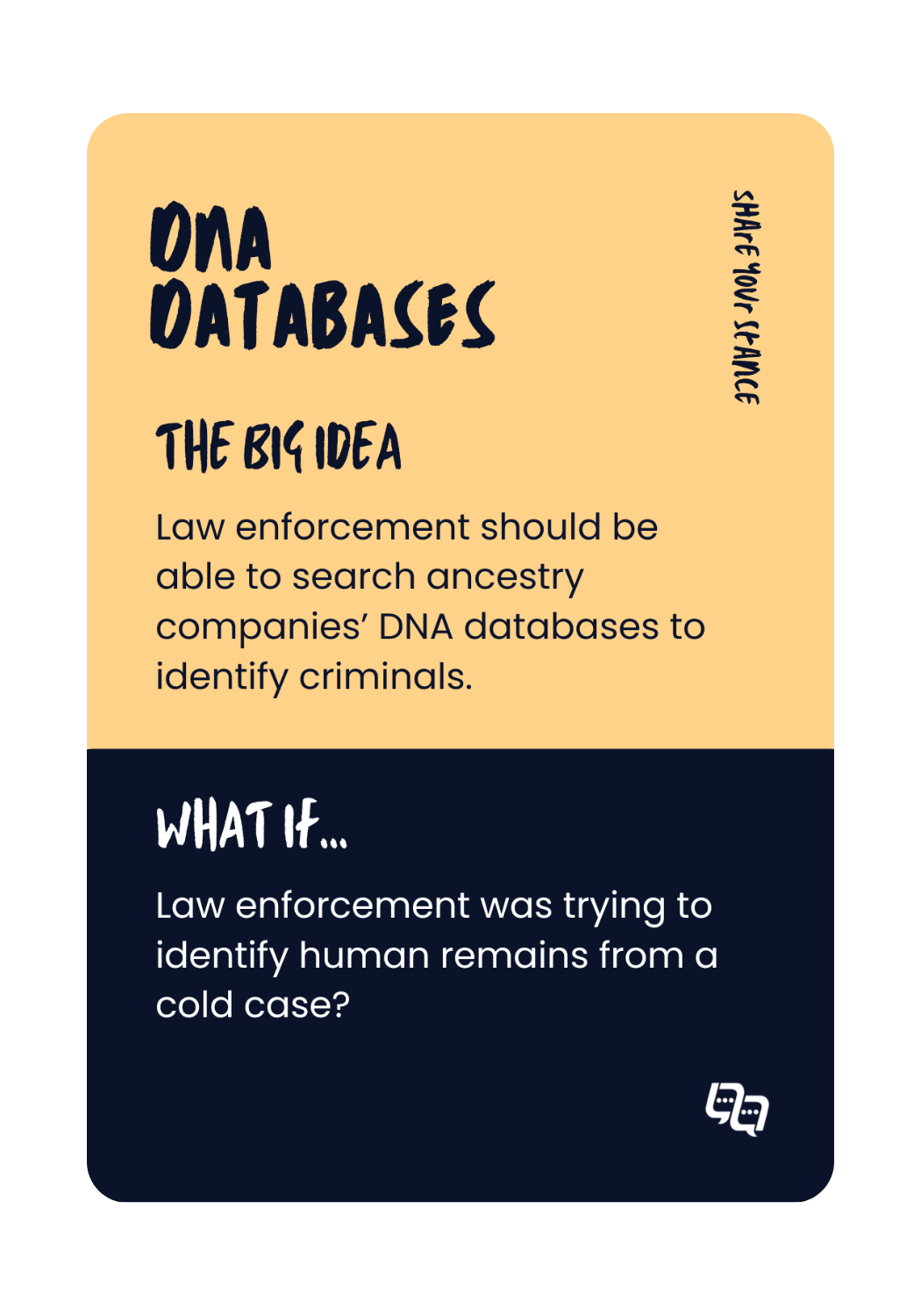
Law enforcement should be able to search ancestry companies’ DNA databases to identify criminals.
Examples of Reasons to Agree
- They have done this in the past with success.
- Law enforcement should be able to use any means available to catch criminals.
- As long as the company is transparent with their customers and includes this in their terms of service, I’m fine with it.
Examples of Reasons to Disagree
- I don’t want law enforcement to be able to access my genetic information without my permission. That’s a violation of my privacy.
- It would freak me out if I learned that a relative of mine was arrested because law enforcement used my DNA to solve the case. I would feel indirectly involved in their arrest.
What if law enforcement was trying to identify human remains from a cold case?
In this situation, it is to be assumed that you are a relative of the victim. And, the victim is likely to have been deceased for some time. This factor might alter how someone feels about law enforcement using their DNA to solve the case. It might make them feel more emotionally removed from the situation. Or, it might reopen wounds that have taken time to heal from the loss of their relative.
Resources compiled for deeper exploration of these topics through various media outlets:
- ASHG (XXXX). The Genetic Information Nondiscrimination Act (GINA). American Society of Human Genetics (Blog).
- JAX Clinical Education (2024). GINA: Case Studies. The Jackson Laboratory.
- Brown, K.V. (2024). Genetic discrimination is coming for us all. The Atlantic.
- Bala N (2020). Why are you publicly sharing your child’s DNA information? The New York Times.
- Kaiser, J. (2019). A judge said police can search the DNA of 1 million Americans without their consent. What’s next? Science Advisor (Newsletter).
- Rose, E. (2014) Should genetics be a deal breaker in the dating scene? Albert Einstein College of Medicine.
I would want to know if someone I was seriously dating had a strong predisposition for a genetic condition.
Examples of Reasons to Agree
- Because some genetic conditions can be passed down to children, and I know I want to have biological children, I would want to know what the risk could be to our future kids.
- Some genetic conditions affect people as they grow older, so I would want to know if there’s something I’d need to do to care for my partner in the future.
- If there was something I could do to help or better support them right now, I would want to know.
Examples of Reasons to Disagree
- That’s their private health information. I don’t need to know that.
- Unless we’re getting married or having children, I wouldn’t expect someone I was dating to disclose this information.
- It would just make me worried for them. I would focus more on their health than our relationship.
- I don’t think genetic information should impact the way I feel toward someone I’m dating.
What if you were the one with the genetic predisposition?
A person’s perspective on this topic might change if they imagine themselves as the one with the genetic predisposition. It can feel different to be viewed as the one “affected” by something they likely cannot change. Responses to this question may also differ depending on the perceived life impact of the genetic condition. This might impact their views about the privacy of the information, or how and when they might choose to share personal genetic information with a dating partner.
Insurance companies should be able to request genetic information from the people they cover.
Examples of Reasons to Agree
- There might be plans that are better suited to people with specific types of genetic predispositions or conditions.
Examples of Reasons to Disagree
- The information could be used to raise premiums, making healthcare far less affordable than it already is for many people.
- I want to keep my genetic information private. I worry that other companies might gain access to my data somehow.
What if coverage could be provided for preventative care for a person with an increased health risk?
This question is typically met with a resounding “disagree”. However, some employers are beginning to offer genetic testing and genetic healthcare services as health benefits for their employees. This would decrease the cost of genetic services, which can be expensive and inaccessible for many people.
People should be able to learn whatever they want about their DNA because it is their body.
Examples of Reasons to Agree
- People should have the autonomy and right to choose if, how, and when they learn about their genetic information.
- Not all doctors routinely order genetic testing. Sometimes, the consumer knows what is most helpful for them. By taking an at-home DNA test, I learned I had a genetic predisposition for a disorder.
- I can handle whatever I learn from genetic testing, whether it’s positive results or negative.
Examples of Reasons to Disagree
- Sometimes, because of the emotional or medical implications, genetic information is difficult to learn – even if a person feels they’re mentally prepared.
- A person seeking genetic information probably has questions that can be best answered by a genetic healthcare professional.
- People should only be able to learn what’s medically relevant to them, or things they can take medical action to address.
- People learn about their DNA in different ways, either through a clinical test ordered by a healthcare professional or by doing an at-home DNA test. Some of those tests are inaccurate or take advantage of people’s lack of knowledge about genetics.
What if parents could learn whatever they want to know about their child’s DNA before they turn 18?
Parents who have access to their child’s genetic information might choose to share relevant information about their health during their adolescence or once they mature. Some parents might decide to never share the information unless their child asks directly for it. They might feel that their child isn’t ready to learn about their health risks, or a parent might not feel prepared to answer questions that may come up. On the other hand, some parents might share this information earlier in their child’s life, especially if they learn that their child will develop health challenges as they age.
Employers should be able to make hiring or firing decisions based on a candidate or employee’s genetic health risks.
Examples of Reasons to Agree
- In certain cases, such as with military or aircraft pilot positions, the job requires particular physical aptitudes such as 20/20 vision. This might also apply to people who have a high genetic risk of developing a vision-changing condition during their lifetime.
Examples of Reasons to Disagree
- Employers should not be able to discriminate against candidates based on their genetic information.
- Genetic health information is private to each individual and should not be shared with anyone, let alone a potential employer.
What if employers instead used genetic health information to choose work assignments and offer preventative health benefits?
Responses to this statement might primarily disagree because of the US Genetic Information Non-discrimination Act (GINA), a policy passed in 2008 that prevents employers and health insurers from discriminating against people based on their genetic information. However, employers across the US are starting to offer genetic health benefits to their employees, such as testing and screenings. Whether this will lead to employers accessing the information to choose work assignments or offer preventative health benefits is undetermined (in 2025).
Law enforcement should be able to search ancestry companies’ DNA databases to identify criminals.
Examples of Reasons to Agree
- They have done this in the past with success.
- Law enforcement should be able to use any means available to catch criminals.
- As long as the company is transparent with their customers and includes this in their terms of service, I’m fine with it.
Examples of Reasons to Disagree
- I don’t want law enforcement to be able to access my genetic information without my permission. That’s a violation of my privacy.
- It would freak me out if I learned that a relative of mine was arrested because law enforcement used my DNA to solve the case. I would feel indirectly involved in their arrest.
What if law enforcement was trying to identify human remains from a cold case?
In this situation, it is to be assumed that you are a relative of the victim. And, the victim is likely to have been deceased for some time. This factor might alter how someone feels about law enforcement using their DNA to solve the case. It might make them feel more emotionally removed from the situation. Or, it might reopen wounds that have taken time to heal from the loss of their relative.
Resources compiled for deeper exploration of these topics through various media outlets:
- ASHG (XXXX). The Genetic Information Nondiscrimination Act (GINA). American Society of Human Genetics (Blog).
- JAX Clinical Education (2024). GINA: Case Studies. The Jackson Laboratory.
- Brown, K.V. (2024). Genetic discrimination is coming for us all. The Atlantic.
- Bala N (2020). Why are you publicly sharing your child’s DNA information? The New York Times.
- Kaiser, J. (2019). A judge said police can search the DNA of 1 million Americans without their consent. What’s next? Science Advisor (Newsletter).
- Rose, E. (2014) Should genetics be a deal breaker in the dating scene? Albert Einstein College of Medicine.