What Does the Card Deck Include?
- 25 discussion cards across 5 categories. Each discussion card contains a ‘Big Idea’ statement and a ‘What If…’ question.
- 15 challenge cards that offer an action, question, or idea to consider with a discussion card.
- 2 rule cards for reference during gameplay.






Environment
We should use genetically engineered microbes to break down plastics in landfills.
Examples of Reasons to Agree
- Plastic pollution is a huge problem for the environment. We should do whatever is necessary to break it down.
- Genetically engineered microbes can be programmed to break down a large variety of plastics.
Examples of Reasons to Disagree
- I don’t think we should introduce genetically engineered organisms of any size, even microbes, into the ecosystem. They might negatively affect other organisms or environmental processes.
- I assume there would be waste produced from the process of breaking down the plastics. Who knows if those waste products are any safer for the environment than the plastics themselves?
What if we used them to clean pollutants created by industrial processes?
Certain types of microbes can be genetically engineered to break down plastics and even industrial waste. These programmable microbes present the potential to remove a large amount of pollutants from our environment. However, the downstream effects of these microbes are unknown. Some people worry that they will outcompete endemic soil microbes for resources and cause an environmental disaster.
Astronauts should modify their DNA to be less susceptible to the effects of radiation during space travel.
Examples of Reasons to Agree
- Astronauts are at increased risk of developing cancer due to radiation exposure. If editing their DNA could help, I think they should do it.
- Astronauts are risking their lives to learn new things about our universe. They should be able to do what they want with their DNA to protect themselves.
Examples of Reasons to Disagree
- I am against the idea of editing human DNA, regardless of whatever protections it might afford in this case.
- I am concerned that the edits may protect them from radiation but might have other negative effects.
- It seems like this would be very expensive technology to develop, and would benefit very few people.
What if these same modifications could be used by non-astronauts to prevent skin cancer?
While modifications to protect astronauts from radiation would serve a very limited number of people, all of us are exposed to radiation from the sun, x-rays, and other sources, such as radon, in our homes. Approximately 1 in 5 Americans will develop skin cancer by age 70. Many inventions we all take for granted today (such as memory foam mattresses, wireless headsets, and camera phones) were first developed by researchers in our space program. This research could save millions of lives.
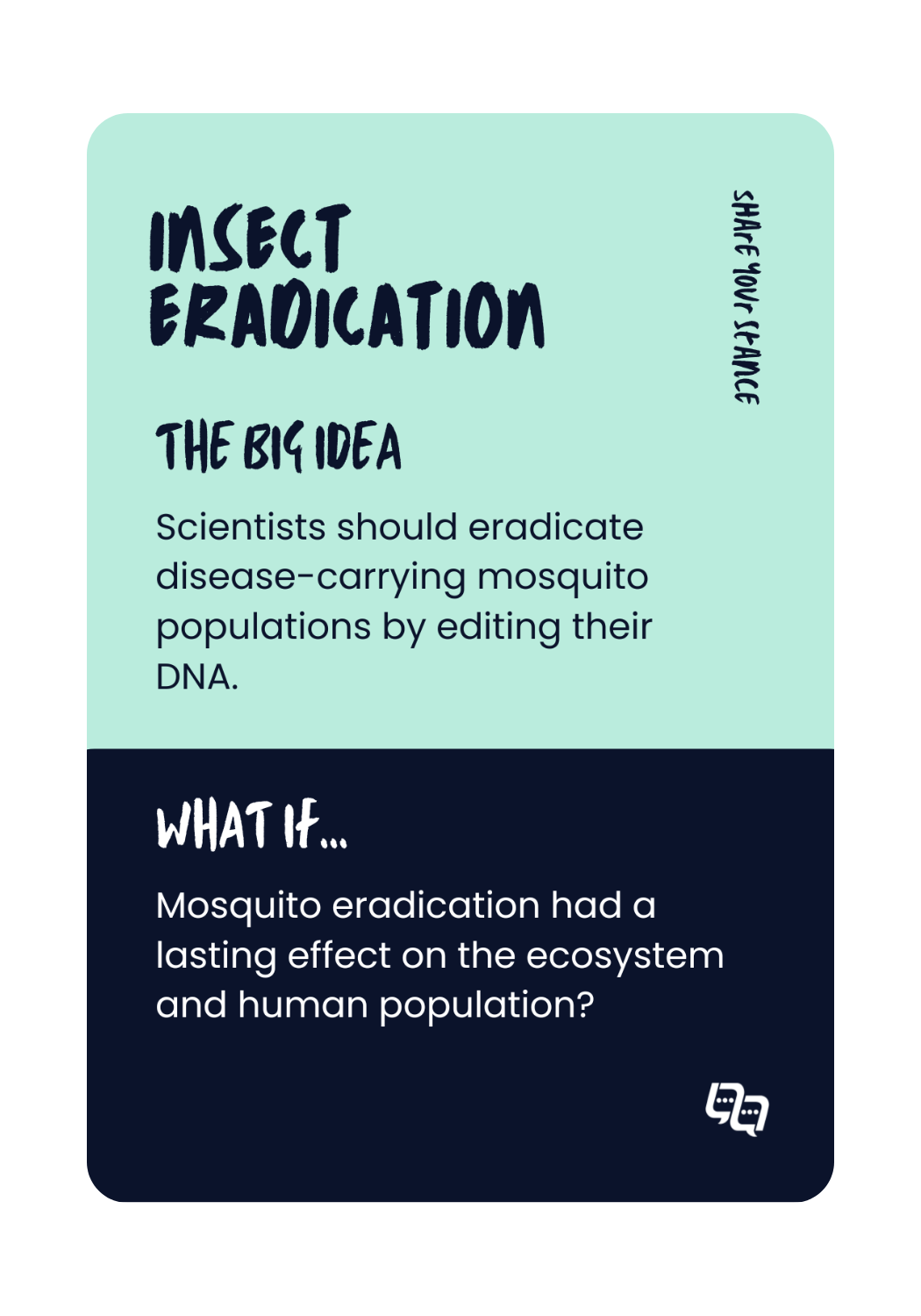
Scientists should eradicate disease-carrying mosquito populations by editing their DNA.
Examples of Reasons to Agree
- Nobody likes mosquitoes. Get rid of them.
- Mosquitoes are the deadliest animals on Earth. Malaria alone infects millions and kills hundreds of thousands of people annually. Current measures like eliminating standing water and using mosquito nets are helpful, but not to the degree necessary.
Examples of Reasons to Disagree
- Mosquitoes serve as a food source for other species (such as birds, frogs, and lizards). Eradicating them may disrupt the ecosystem.
- I worry that eradicating mosquitoes might allow the population of another pest to increase and cause a bigger problem.
What if mosquito eradication had a lasting effect on the ecosystem and human population?
It is nearly certain that eradication would have a lasting effect on both people and the ecosystem. The big question is whether those impacts would be a net positive or negative. Many approaches to editing the DNA of mosquitoes to eradicate insect-borne diseases are being researched.
We should genetically engineer trees to store more carbon from the atmosphere to slow the effects of global warming.
Examples of Reasons to Agree
- Global warming is a serious issue, and we should explore unique solutions. Genetically modifying trees might be a solution that is scalable enough to make a big difference.
Examples of Reasons to Disagree
- I am concerned that the modifications to store more carbon might cause other unknown issues.
- What happens when we cut down the trees? Do they still hold on to that extra carbon, or is it returned to the atmosphere?
What if the genetically engineered trees outcompete existing trees for resources?
People who already disagree with the idea of genetically engineering trees to store more carbon might be concerned about how these trees would affect other organisms in their ecosystem. Those who were in favor of the original idea may change their mind when considering how these trees could have negative effects like outcompeting native species. Much study is needed before implementing these types of solutions in the wild.
Scientists should use genetic technologies to revive extinct animals.
Examples of Reasons to Agree
- Many animals have gone extinct because of human actions. Reviving these species would be like righting a wrong.
- There are many fascinating extinct species (both prehistoric and more recent). I would be curious to see them in real life.
- Reviving an extinct species could help to rebalance certain ecosystems.
Examples of Reasons to Disagree
- There is a reason these animals are extinct. We should leave it alone.
- I think we should spend our time and resources on conservation instead of trying to bring back what is already lost.
- Reviving an extinct species could completely disrupt established ecosystems.
- If a species has been extinct for a long time, the ecosystem they lived in may no longer exist anywhere on Earth.
- Have you ever seen Jurassic Park? It didn’t go well.
What if scientists proposed to revive extinct plant species?
The idea of de-extinction is a new one for many people, and most people initially think of animal de-extinction. But the same process could be used to revive extinct plant species. Some people may be more open to the idea of reviving extinct plants, especially if they have medicinal properties. Others don’t think we should be trying to bring back any extinct species–plants or animals.
Resources compiled for deeper exploration of these topics through various media outlets:
- Hearn T. (2025). Can we really resurrect extinct animals or are we just creating high-tech lookalikes? The Conversation.
- Grandoni D. (2025). We finally may be able to rid the world of mosquitoes. But should we? Washington Post.
- Williams B. (2025). Five questions for a de-extinction specialist. Trends, an official publication of the American Animal Hospital Association (blog).
- Allen G. (2024). New gene-editing tools may help wipe out mosquito-borne diseases. NPR.
- Ortega L. (2024). Plastic-eating bacteria could combat pollution problems, scientists hope. Washington Post.
- Osborne M (2023). Genetically modified trees are taking root to capture carbon. Smithsonian Magazine.
- Gohd C. (2019). Can We Genetically Engineer Humans to Survive Missions to Mars? Space.com.
We should use genetically engineered microbes to break down plastics in landfills.
Examples of Reasons to Agree
- Plastic pollution is a huge problem for the environment. We should do whatever is necessary to break it down.
- Genetically engineered microbes can be programmed to break down a large variety of plastics.
Examples of Reasons to Disagree
- I don’t think we should introduce genetically engineered organisms of any size, even microbes, into the ecosystem. They might negatively affect other organisms or environmental processes.
- I assume there would be waste produced from the process of breaking down the plastics. Who knows if those waste products are any safer for the environment than the plastics themselves?
What if we used them to clean pollutants created by industrial processes?
Certain types of microbes can be genetically engineered to break down plastics and even industrial waste. These programmable microbes present the potential to remove a large amount of pollutants from our environment. However, the downstream effects of these microbes are unknown. Some people worry that they will outcompete endemic soil microbes for resources and cause an environmental disaster.
Astronauts should modify their DNA to be less susceptible to the effects of radiation during space travel.
Examples of Reasons to Agree
- Astronauts are at increased risk of developing cancer due to radiation exposure. If editing their DNA could help, I think they should do it.
- Astronauts are risking their lives to learn new things about our universe. They should be able to do what they want with their DNA to protect themselves.
Examples of Reasons to Disagree
- I am against the idea of editing human DNA, regardless of whatever protections it might afford in this case.
- I am concerned that the edits may protect them from radiation but might have other negative effects.
- It seems like this would be very expensive technology to develop, and would benefit very few people.
What if these same modifications could be used by non-astronauts to prevent skin cancer?
While modifications to protect astronauts from radiation would serve a very limited number of people, all of us are exposed to radiation from the sun, x-rays, and other sources, such as radon, in our homes. Approximately 1 in 5 Americans will develop skin cancer by age 70. Many inventions we all take for granted today (such as memory foam mattresses, wireless headsets, and camera phones) were first developed by researchers in our space program. This research could save millions of lives.
Scientists should eradicate disease-carrying mosquito populations by editing their DNA.
Examples of Reasons to Agree
- Nobody likes mosquitoes. Get rid of them.
- Mosquitoes are the deadliest animals on Earth. Malaria alone infects millions and kills hundreds of thousands of people annually. Current measures like eliminating standing water and using mosquito nets are helpful, but not to the degree necessary.
Examples of Reasons to Disagree
- Mosquitoes serve as a food source for other species (such as birds, frogs, and lizards). Eradicating them may disrupt the ecosystem.
- I worry that eradicating mosquitoes might allow the population of another pest to increase and cause a bigger problem.
What if mosquito eradication had a lasting effect on the ecosystem and human population?
It is nearly certain that eradication would have a lasting effect on both people and the ecosystem. The big question is whether those impacts would be a net positive or negative. Many approaches to editing the DNA of mosquitoes to eradicate insect-borne diseases are being researched.
We should genetically engineer trees to store more carbon from the atmosphere to slow the effects of global warming.
Examples of Reasons to Agree
- Global warming is a serious issue, and we should explore unique solutions. Genetically modifying trees might be a solution that is scalable enough to make a big difference.
Examples of Reasons to Disagree
- I am concerned that the modifications to store more carbon might cause other unknown issues.
- What happens when we cut down the trees? Do they still hold on to that extra carbon, or is it returned to the atmosphere?
What if the genetically engineered trees outcompete existing trees for resources?
People who already disagree with the idea of genetically engineering trees to store more carbon might be concerned about how these trees would affect other organisms in their ecosystem. Those who were in favor of the original idea may change their mind when considering how these trees could have negative effects like outcompeting native species. Much study is needed before implementing these types of solutions in the wild.
Scientists should use genetic technologies to revive extinct animals.
Examples of Reasons to Agree
- Many animals have gone extinct because of human actions. Reviving these species would be like righting a wrong.
- There are many fascinating extinct species (both prehistoric and more recent). I would be curious to see them in real life.
- Reviving an extinct species could help to rebalance certain ecosystems.
Examples of Reasons to Disagree
- There is a reason these animals are extinct. We should leave it alone.
- I think we should spend our time and resources on conservation instead of trying to bring back what is already lost.
- Reviving an extinct species could completely disrupt established ecosystems.
- If a species has been extinct for a long time, the ecosystem they lived in may no longer exist anywhere on Earth.
- Have you ever seen Jurassic Park? It didn’t go well.
What if scientists proposed to revive extinct plant species?
The idea of de-extinction is a new one for many people, and most people initially think of animal de-extinction. But the same process could be used to revive extinct plant species. Some people may be more open to the idea of reviving extinct plants, especially if they have medicinal properties. Others don’t think we should be trying to bring back any extinct species–plants or animals.
Resources compiled for deeper exploration of these topics through various media outlets:
- Hearn T. (2025). Can we really resurrect extinct animals or are we just creating high-tech lookalikes? The Conversation.
- Grandoni D. (2025). We finally may be able to rid the world of mosquitoes. But should we? Washington Post.
- Williams B. (2025). Five questions for a de-extinction specialist. Trends, an official publication of the American Animal Hospital Association (blog).
- Allen G. (2024). New gene-editing tools may help wipe out mosquito-borne diseases. NPR.
- Ortega L. (2024). Plastic-eating bacteria could combat pollution problems, scientists hope. Washington Post.
- Osborne M (2023). Genetically modified trees are taking root to capture carbon. Smithsonian Magazine.
- Gohd C. (2019). Can We Genetically Engineer Humans to Survive Missions to Mars? Space.com.