What Does the Card Deck Include?
- 25 discussion cards across 5 categories. Each discussion card contains a ‘Big Idea’ statement and a ‘What If…’ question.
- 15 challenge cards that offer an action, question, or idea to consider with a discussion card.
- 2 rule cards for reference during gameplay.




Human Health
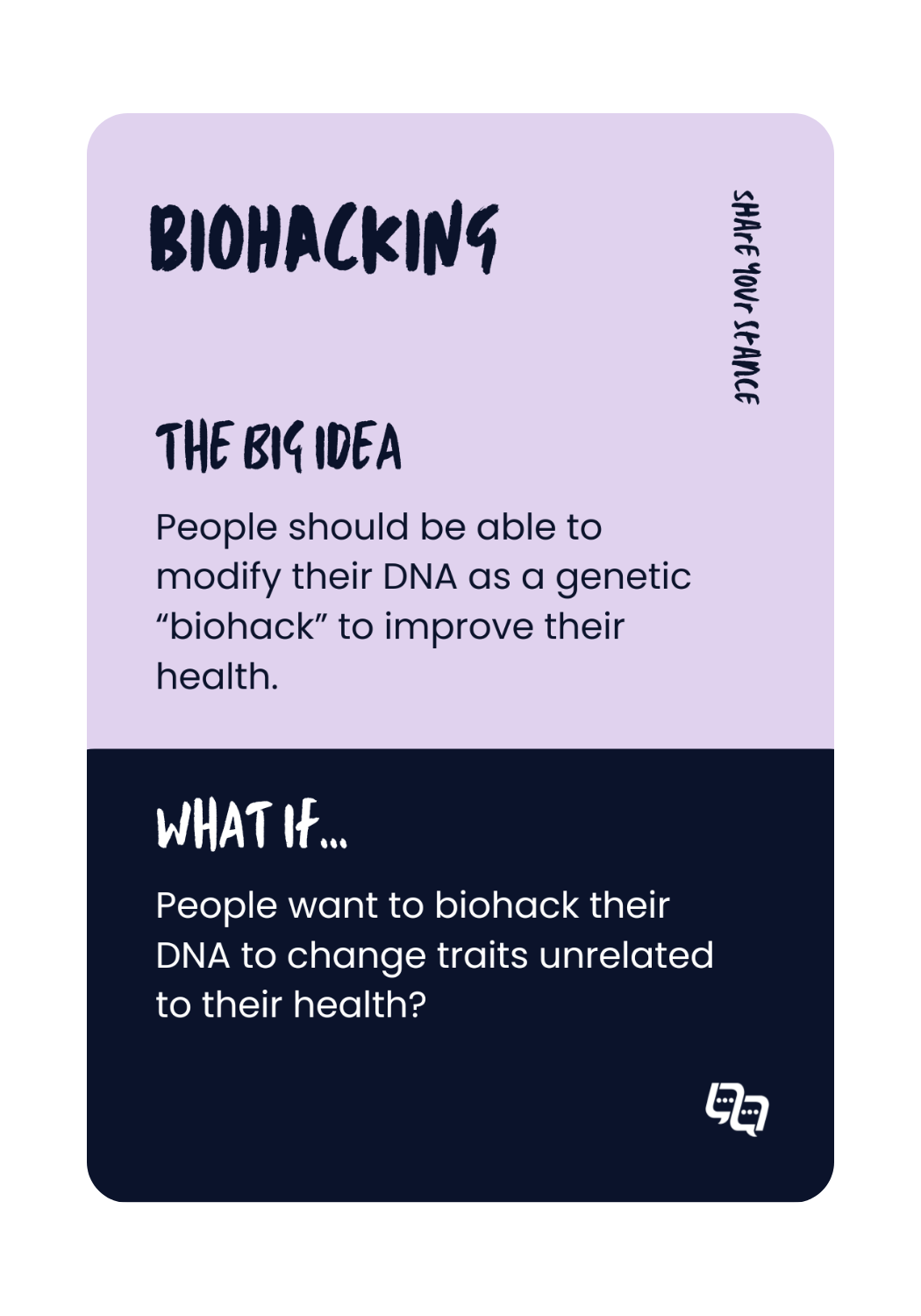
People should be able to modify their DNA as a genetic “biohack” to improve their health.
Examples of Reasons to Agree
- People should be able to do whatever they want with their bodies.
- As long as the edits aren’t passed on to future generations, it’s not a problem.
- We do other things to improve our health. Why not edit our DNA?
Examples of Reasons to Disagree
- The risk of something going wrong is too high.
- Editing people’s DNA is a step too far. It should be off-limits.
- Mistakes might be made. These mistakes might be passed on to future generations.
People want to biohack their DNA to change traits unrelated to their health?
When considering human genome editing, some people fall on the far ends of the spectrum, either believing that people should be able to do whatever they want with their DNA or that human DNA should not be edited for any reason. For those in the middle of that spectrum, health applications are often an important dividing line, with more people in favor of edits to improve health than to change a trait for non-medical purposes. Genome editing for non-medical purposes is referred to as “enhancement”. Deciding where to draw the line between enhancements and health purposes can sometimes be difficult.
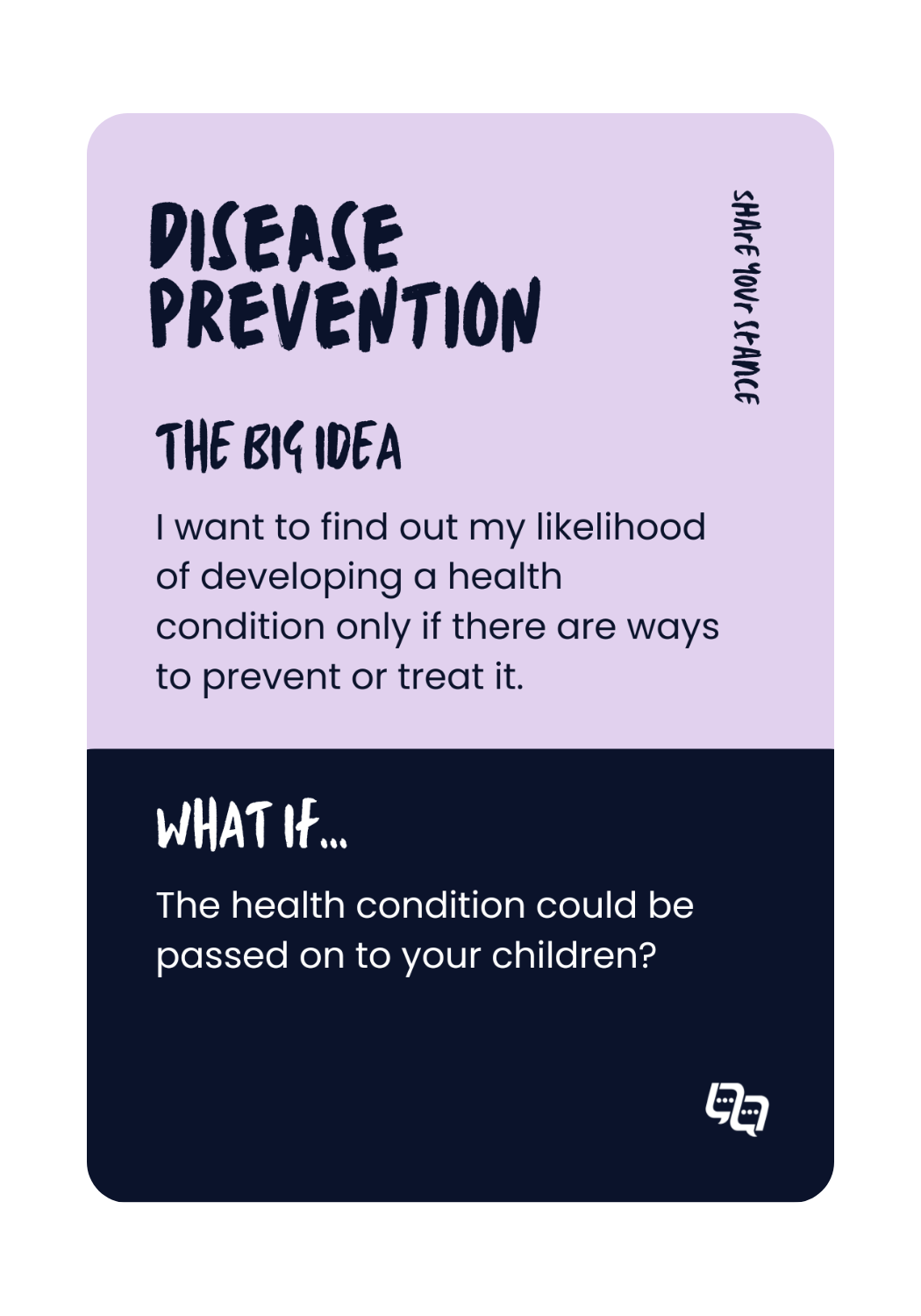
I want to find out my likelihood of developing a health condition only if there are ways to prevent or treat it.
Examples of Reasons to Agree
- If there was something I could do to prevent or treat it, I would want to know so I could improve my health.
- Why would I want to know if there was nothing I could do about it? It would just stress me out or make me depressed.
Examples of Reasons to Disagree
- I wouldn’t want to know either way. I would rather wait until I have symptoms than know ahead of time that I might develop some sort of health condition.
- Knowledge is power. I’d want to know even if there was no way to prevent or treat it so I could make decisions about my future. If my life might be limited in the future due to a health concern, I might want to plan for retirement differently or do some bucket list items sooner.
- I would want to know for family planning reasons. Knowing I might have a genetic predisposition for a health condition might change whether or how I choose to have children, or it might be important for my children to know so they can get screened or make their own family planning decisions.
- Even if there isn’t anything I could do right now to prevent or treat it, there might be in the future. By knowing my likelihood, I could pay attention to developments in the field or participate in a clinical trial if available.
What if the health condition could be passed on to your children?
People who would want to know about their likelihood of developing a health condition and whether they could do anything to prevent or treat it are often even more assured of their decision when considering that this information might have health implications for their children. People who may not want to know their likelihood of developing a health condition may change their minds when considering whether their children could be at risk. But, some people would still prefer not to know regardless of whether their children might be affected due to the psychological impact of the knowledge.
I would accept an organ transplant from a pig.
Examples of Reasons to Agree
- If I were sick enough to need an organ transplant, I would be willing to take any organ I could get if it might save my life.
- I would be willing to if it had been tested for safety and other people had successfully gone through the same procedure.
Examples of Reasons to Disagree
- Accepting an organ from another animal seems weird. I don’t trust that it would work.
- I worry about biological compatibility. A non-human organ is at risk of being rejected by the human body.
- This technology is still in its early stages. I wouldn’t be willing to volunteer for it now, but maybe in the future after thorough testing is performed.
What if the transplant is a temporary solution until a human organ is available?
One potential use for animal tissue transplants is as a stop-gap measure to buy time until a suitable human transplant organ is available. This has been done with skin transplants, where pig skin was used temporarily until a graft from the person’s skin could be grown and transplanted. Another possibility is that a person who is currently too sick to qualify for a human organ transplant could receive a temporary transplant of a pig organ and, because of the functioning of that organ, become healthy enough to qualify for a human organ later.
I would accept gene therapy to treat a life-limiting health condition.
Examples of Reasons to Agree
- I want to live a long, healthy life. I’d be willing to accept a gene therapy if it would help me achieve that goal.
- Gene therapy might not be my first choice of medical intervention if I were sick. However, if I had to choose between dying or taking the therapy, I would try it. I’d have nothing to lose.
Examples of Reasons to Disagree
- I don’t believe we should be messing with our genetic make-up.
- I’ve heard about unsuccessful cases of gene therapy treatments in the past, and I’d be afraid to have a poor outcome myself.
- Gene therapies are too new and experimental for my comfort level. I don’t want to take any unnecessary risks, especially if I am already sick.
What if you would be the first person in the world to receive the treatment?
Given the rapid pace of development of genetic technologies, there will be many new gene therapies on the market in the coming years. For any of these treatments to be available, someone has to be the first to receive the treatment in a clinical trial. While medical treatments of any kind have to go through extensive testing in the lab and on animals to demonstrate safety and effectiveness before reaching the human trial phase, the only way for us to know whether it will work in humans is to test it on humans. Participating in a clinical trial is risky, but carries the potential to produce an effective treatment for many other people living with genetic health conditions.
Relatives should share their genetic health information so people can better understand their familial health risks.
Examples of Reasons to Agree
- If I learn about genetic health information that could help someone in my family be healthier, I would want to share it.
- Some people in a family may have more access to quality healthcare than others. If I share my information, this might help someone in my family who has less access to this information.
- My family likes to be proactive about making lifestyle changes based on health information. I’d share my genetic information if it might help us reduce our chances of having health issues in the future.
Examples of Reasons to Disagree
- Genetic health information is very personal, and I would not want to share it with anyone, even my family.
- How would this information ever be welcomed by my family members? Even if I wanted to share the information, I would still keep it to myself.
- My family doesn’t talk about health. I don’t think conversations about health issues in general, let alone about issues that could potentially impact multiple people, would be received well.
What if you would learn that you have a significantly increased risk for a serious health condition?
Many health conditions are polygenic. This means that many genes play a small role in determining a person’s risk for developing the condition. Learning that you have a gene variant that increases your risk of developing a health condition by 1-2% may not be very impactful. Other health conditions can be strongly affected or even caused by a single gene. Learning that you have a disease-causing variant of one of these genes can be life-changing. You might need to change the foods you eat, take new medications, or consider the impact on any children you have or the way you might plan to have children in the future.
Resources compiled for deeper exploration of these topics through various media outlets:
- Anand, R. (2018) The dangers of biohacking and how it could harm your health. The Conversation.
- Cohen, J. (2025). The Organ Farm. Science.
- Schmerling, RH (2021). Tempted to have genetic testing? First ask why. Harvard Health.
- Stroppa L and Wilson E. (2025) The NHS plan to genetically test all newborns sounds smart – until it creates patients who aren’t sick. The Conversation.
- Inampudi, A. (2025). Genetic testing of critically ill adults can yield surprises—and reveal disparities in treatment of Black patients. Science.
- Azar, S. (2025). Finding Relief After Years of Unbearable Pain from Sickle Cell Disease: Allan’s Story. Mass General Birmingham.
- Gilbert, D. Two boys died after a gene therapy. This family won’t give up hope. Washington Post.
People should be able to modify their DNA as a genetic “biohack” to improve their health.
Examples of Reasons to Agree
- People should be able to do whatever they want with their bodies.
- As long as the edits aren’t passed on to future generations, it’s not a problem.
- We do other things to improve our health. Why not edit our DNA?
Examples of Reasons to Disagree
- The risk of something going wrong is too high.
- Editing people’s DNA is a step too far. It should be off-limits.
- Mistakes might be made. These mistakes might be passed on to future generations.
People want to biohack their DNA to change traits unrelated to their health?
When considering human genome editing, some people fall on the far ends of the spectrum, either believing that people should be able to do whatever they want with their DNA or that human DNA should not be edited for any reason. For those in the middle of that spectrum, health applications are often an important dividing line, with more people in favor of edits to improve health than to change a trait for non-medical purposes. Genome editing for non-medical purposes is referred to as “enhancement”. Deciding where to draw the line between enhancements and health purposes can sometimes be difficult.
I want to find out my likelihood of developing a health condition only if there are ways to prevent or treat it.
Examples of Reasons to Agree
- If there was something I could do to prevent or treat it, I would want to know so I could improve my health.
- Why would I want to know if there was nothing I could do about it? It would just stress me out or make me depressed.
Examples of Reasons to Disagree
- I wouldn’t want to know either way. I would rather wait until I have symptoms than know ahead of time that I might develop some sort of health condition.
- Knowledge is power. I’d want to know even if there was no way to prevent or treat it so I could make decisions about my future. If my life might be limited in the future due to a health concern, I might want to plan for retirement differently or do some bucket list items sooner.
- I would want to know for family planning reasons. Knowing I might have a genetic predisposition for a health condition might change whether or how I choose to have children, or it might be important for my children to know so they can get screened or make their own family planning decisions.
- Even if there isn’t anything I could do right now to prevent or treat it, there might be in the future. By knowing my likelihood, I could pay attention to developments in the field or participate in a clinical trial if available.
What if the health condition could be passed on to your children?
People who would want to know about their likelihood of developing a health condition and whether they could do anything to prevent or treat it are often even more assured of their decision when considering that this information might have health implications for their children. People who may not want to know their likelihood of developing a health condition may change their minds when considering whether their children could be at risk. But, some people would still prefer not to know regardless of whether their children might be affected due to the psychological impact of the knowledge.
I would accept an organ transplant from a pig.
Examples of Reasons to Agree
- If I were sick enough to need an organ transplant, I would be willing to take any organ I could get if it might save my life.
- I would be willing to if it had been tested for safety and other people had successfully gone through the same procedure.
Examples of Reasons to Disagree
- Accepting an organ from another animal seems weird. I don’t trust that it would work.
- I worry about biological compatibility. A non-human organ is at risk of being rejected by the human body.
- This technology is still in its early stages. I wouldn’t be willing to volunteer for it now, but maybe in the future after thorough testing is performed.
What if the transplant is a temporary solution until a human organ is available?
One potential use for animal tissue transplants is as a stop-gap measure to buy time until a suitable human transplant organ is available. This has been done with skin transplants, where pig skin was used temporarily until a graft from the person’s skin could be grown and transplanted. Another possibility is that a person who is currently too sick to qualify for a human organ transplant could receive a temporary transplant of a pig organ and, because of the functioning of that organ, become healthy enough to qualify for a human organ later.
I would accept gene therapy to treat a life-limiting health condition.
Examples of Reasons to Agree
- I want to live a long, healthy life. I’d be willing to accept a gene therapy if it would help me achieve that goal.
- Gene therapy might not be my first choice of medical intervention if I were sick. However, if I had to choose between dying or taking the therapy, I would try it. I’d have nothing to lose.
Examples of Reasons to Disagree
- I don’t believe we should be messing with our genetic make-up.
- I’ve heard about unsuccessful cases of gene therapy treatments in the past, and I’d be afraid to have a poor outcome myself.
- Gene therapies are too new and experimental for my comfort level. I don’t want to take any unnecessary risks, especially if I am already sick.
What if you would be the first person in the world to receive the treatment?
Given the rapid pace of development of genetic technologies, there will be many new gene therapies on the market in the coming years. For any of these treatments to be available, someone has to be the first to receive the treatment in a clinical trial. While medical treatments of any kind have to go through extensive testing in the lab and on animals to demonstrate safety and effectiveness before reaching the human trial phase, the only way for us to know whether it will work in humans is to test it on humans. Participating in a clinical trial is risky, but carries the potential to produce an effective treatment for many other people living with genetic health conditions.
Relatives should share their genetic health information so people can better understand their familial health risks.
Examples of Reasons to Agree
- If I learn about genetic health information that could help someone in my family be healthier, I would want to share it.
- Some people in a family may have more access to quality healthcare than others. If I share my information, this might help someone in my family who has less access to this information.
- My family likes to be proactive about making lifestyle changes based on health information. I’d share my genetic information if it might help us reduce our chances of having health issues in the future.
Examples of Reasons to Disagree
- Genetic health information is very personal, and I would not want to share it with anyone, even my family.
- How would this information ever be welcomed by my family members? Even if I wanted to share the information, I would still keep it to myself.
- My family doesn’t talk about health. I don’t think conversations about health issues in general, let alone about issues that could potentially impact multiple people, would be received well.
What if you would learn that you have a significantly increased risk for a serious health condition?
Many health conditions are polygenic. This means that many genes play a small role in determining a person’s risk for developing the condition. Learning that you have a gene variant that increases your risk of developing a health condition by 1-2% may not be very impactful. Other health conditions can be strongly affected or even caused by a single gene. Learning that you have a disease-causing variant of one of these genes can be life-changing. You might need to change the foods you eat, take new medications, or consider the impact on any children you have or the way you might plan to have children in the future.
Resources compiled for deeper exploration of these topics through various media outlets:
- Anand, R. (2018) The dangers of biohacking and how it could harm your health. The Conversation.
- Cohen, J. (2025). The Organ Farm. Science.
- Schmerling, RH (2021). Tempted to have genetic testing? First ask why. Harvard Health.
- Stroppa L and Wilson E. (2025) The NHS plan to genetically test all newborns sounds smart – until it creates patients who aren’t sick. The Conversation.
- Inampudi, A. (2025). Genetic testing of critically ill adults can yield surprises—and reveal disparities in treatment of Black patients. Science.
- Azar, S. (2025). Finding Relief After Years of Unbearable Pain from Sickle Cell Disease: Allan’s Story. Mass General Birmingham.
- Gilbert, D. Two boys died after a gene therapy. This family won’t give up hope. Washington Post.