What Does the Card Deck Include?
- 25 discussion cards across 5 categories. Each discussion card contains a ‘Big Idea’ statement and a ‘What If…’ question.
- 15 challenge cards that offer an action, question, or idea to consider with a discussion card.
- 2 rule cards for reference during gameplay.






Agriculture
I would eat meat from animals that were genetically modified to produce more muscle.
Examples of Reasons to Agree
- If each animal produced more muscle/meat, we would not need to breed, raise, and slaughter as many animals for food production.
- I eat GMO foods anyway – how would a GMO animal be any different?
Examples of Reasons to Disagree
- I don’t eat meat.
- I am uncomfortable with consuming genetically modified foods.
- I worry about how this might impact the animals. Might the extra muscle cause suffering in some way?
What if the meat was lab-grown?
Lab-grown meat is an emerging concept. Some people are excited by the idea of being able to enjoy meat without the environmental impacts of raising livestock or the suffering of animals raised and harvested for food. Some people who have vegetarian or vegan diets for ethical reasons might choose to consume lab-grown meat, for this purpose. Others bristle at the idea of meat that is produced in a bioreactor.
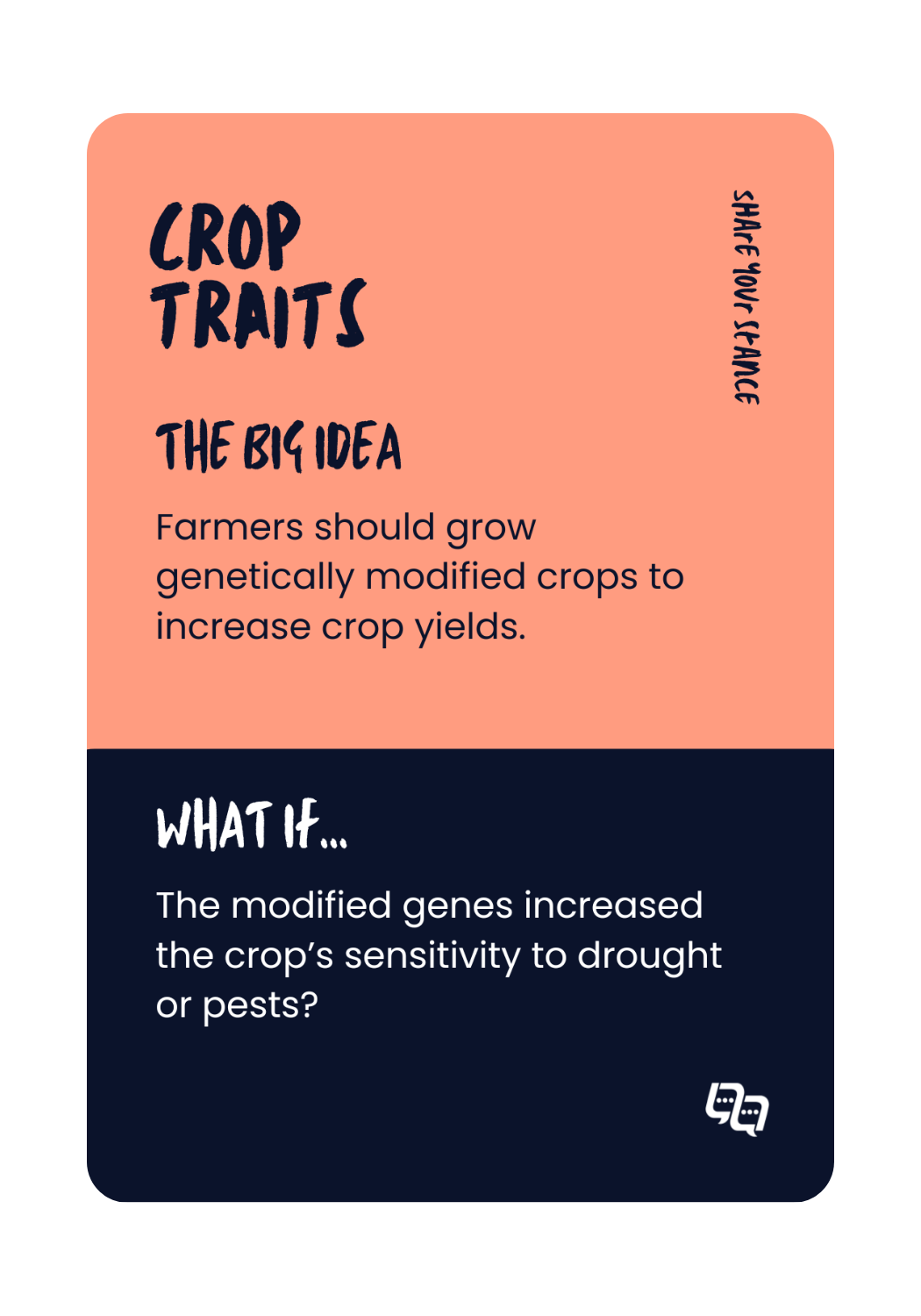
Farmers should grow genetically modified crops to increase crop yields.
Examples of Reasons to Agree
- Increasing crop yields can help us feed a growing population with the same amount of farmland.
- Increasing yield means we can get more food without having to farm more land.
Examples of Reasons to Disagree
- I am uncomfortable eating genetically modified food.
- I worry that the modifications that increase the yield may be harmful in some way.
What if the modified genes increase the crop’s sensitivity to drought or pests?
When solving one problem, we may inadvertently cause another. Many genes serve more than one function in an organism. While a modification might have a positive effect on one trait, it could harm another. Scientists must carefully investigate the impacts of any genetic modifications they make to reduce the chances of negative effects.
Milk that comes from a genetically modified dairy cow should be marketed as a GMO product.
Examples of Reasons to Agree
- Milk contains some DNA from the animal it came from. I would want to know if the milk I was drinking came from a genetically modified cow.
- I wonder if the genetic modifications to the cow would affect the milk in some way.
Examples of Reasons to Disagree
- The genetic modification was done to the cow, not the milk. I am not concerned about consuming the milk from the cow.
What if the modification affects the cow’s horn size and not its milk production?
Some people might feel that the GMO label should only apply to the product they are consuming, and not the source of the product. In this case, a genetically modified cow produced what some would call non-GMO milk. However, other people might argue that because the cow carries a genetic modification that has changed one of its traits, then the milk should also be labeled a GMO product.
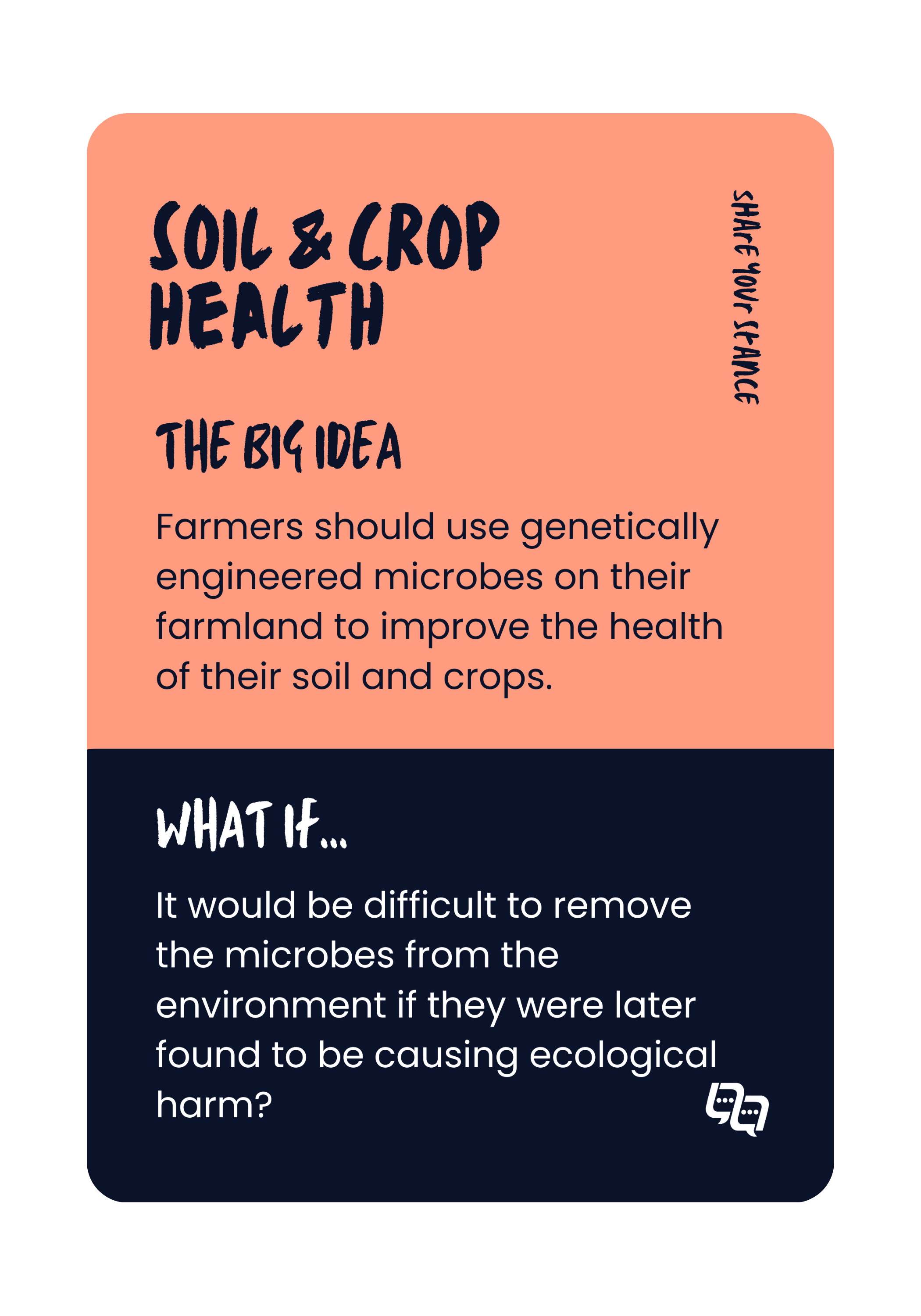
Farmers should use genetically engineered microbes on their farmland to improve the health of their soil and crops.
Examples of Reasons to Agree
- If the presence of genetically engineered microbes would reduce the need for harmful pesticides or fertilizers, I would be in favor of using them.
Examples of Reasons to Disagree
- The idea of genetically modifying anything makes me uncomfortable.
- How could we ensure the microbes stay in the farmland where they were intended? Would there be risks to them spreading more widely?
- I worry that they may disrupt the ecosystem in unexpected ways.
It would be difficult to remove the microbes if they caused an ecological issue?
The difficulty in removing the microbes might be a reason people disagree with the original statement. For those who agree, the idea that the microbes might be difficult to remove or deactivate might change their mind. Ecological impacts must be considered before moving forward with technologies such as this.
We should genetically modify food crops to be more nutritious.
Examples of Reasons to Agree
- Making food more nutritious seems like a good idea, especially in areas of the world where food resources are scarce.
Examples of Reasons to Disagree
- I am uncomfortable with the idea of genetically modifying food, even if the goal is to make it more nutritious. I worry about whether these edits might have any negative effects.
What if the genetically modified seeds were only made available to farmers in a limited number of countries?
Making the seeds only available to farmers in a limited number of countries might raise some red flags. What countries would they be available in? Only rich countries? This raises concerns about inequitable access. Only poorer countries? This makes one wonder whether the seeds are only available there because nutritious food is already available in richer countries or whether there are some concerns about the seeds that make richer countries unlikely to accept them.
Resources compiled for deeper exploration of these topics through various media outlets:
- Bennett H. (2025). US meat could soon be gene-edited. Here’s what that means. BBC Science Focus.
- Quinn L. (2025). Gene-edited soil bacteria could provide third source of nitrogen for corn production. College of Agricultural, Consumer and Environmental Sciences, University of Illinois Urbana-Champaign.
- Maina J. (2022). 5 ways gene editing is making crops climate-resilient. Alliance for Science.
- Furness, D. (2020). Biotechnology Could Change the Cattle Industry. Will it Succeed? Undark.
- Mah A. (2019). Lab-grown meats will change the food industry forever. Synthego.
- Wheeler MB (2013). Transgenic animals in agriculture. Nature Education Knowledge 4(11):1.
I would eat meat from animals that were genetically modified to produce more muscle.
Examples of Reasons to Agree
- If each animal produced more muscle/meat, we would not need to breed, raise, and slaughter as many animals for food production.
- I eat GMO foods anyway – how would a GMO animal be any different?
Examples of Reasons to Disagree
- I don’t eat meat.
- I am uncomfortable with consuming genetically modified foods.
- I worry about how this might impact the animals. Might the extra muscle cause suffering in some way?
What if the meat was lab-grown?
Lab-grown meat is an emerging concept. Some people are excited by the idea of being able to enjoy meat without the environmental impacts of raising livestock or the suffering of animals raised and harvested for food. Some people who have vegetarian or vegan diets for ethical reasons might choose to consume lab-grown meat, for this purpose. Others bristle at the idea of meat that is produced in a bioreactor.
Farmers should grow genetically modified crops to increase crop yields.
Examples of Reasons to Agree
- Increasing crop yields can help us feed a growing population with the same amount of farmland.
- Increasing yield means we can get more food without having to farm more land.
Examples of Reasons to Disagree
- I am uncomfortable eating genetically modified food.
- I worry that the modifications that increase the yield may be harmful in some way.
What if the modified genes increase the crop’s sensitivity to drought or pests?
When solving one problem, we may inadvertently cause another. Many genes serve more than one function in an organism. While a modification might have a positive effect on one trait, it could harm another. Scientists must carefully investigate the impacts of any genetic modifications they make to reduce the chances of negative effects.
Milk that comes from a genetically modified dairy cow should be marketed as a GMO product.
Examples of Reasons to Agree
- Milk contains some DNA from the animal it came from. I would want to know if the milk I was drinking came from a genetically modified cow.
- I wonder if the genetic modifications to the cow would affect the milk in some way.
Examples of Reasons to Disagree
- The genetic modification was done to the cow, not the milk. I am not concerned about consuming the milk from the cow.
What if the modification affects the cow’s horn size and not its milk production?
Some people might feel that the GMO label should only apply to the product they are consuming, and not the source of the product. In this case, a genetically modified cow produced what some would call non-GMO milk. However, other people might argue that because the cow carries a genetic modification that has changed one of its traits, then the milk should also be labeled a GMO product.
Farmers should use genetically engineered microbes on their farmland to improve the health of their soil and crops.
Examples of Reasons to Agree
- If the presence of genetically engineered microbes would reduce the need for harmful pesticides or fertilizers, I would be in favor of using them.
Examples of Reasons to Disagree
- The idea of genetically modifying anything makes me uncomfortable.
- How could we ensure the microbes stay in the farmland where they were intended? Would there be risks to them spreading more widely?
- I worry that they may disrupt the ecosystem in unexpected ways.
It would be difficult to remove the microbes if they caused an ecological issue?
The difficulty in removing the microbes might be a reason people disagree with the original statement. For those who agree, the idea that the microbes might be difficult to remove or deactivate might change their mind. Ecological impacts must be considered before moving forward with technologies such as this.
We should genetically modify food crops to be more nutritious.
Examples of Reasons to Agree
- Making food more nutritious seems like a good idea, especially in areas of the world where food resources are scarce.
Examples of Reasons to Disagree
- I am uncomfortable with the idea of genetically modifying food, even if the goal is to make it more nutritious. I worry about whether these edits might have any negative effects.
What if the genetically modified seeds were only made available to farmers in a limited number of countries?
Making the seeds only available to farmers in a limited number of countries might raise some red flags. What countries would they be available in? Only rich countries? This raises concerns about inequitable access. Only poorer countries? This makes one wonder whether the seeds are only available there because nutritious food is already available in richer countries or whether there are some concerns about the seeds that make richer countries unlikely to accept them.
Resources compiled for deeper exploration of these topics through various media outlets:
- Bennett H. (2025). US meat could soon be gene-edited. Here’s what that means. BBC Science Focus.
- Quinn L. (2025). Gene-edited soil bacteria could provide third source of nitrogen for corn production. College of Agricultural, Consumer and Environmental Sciences, University of Illinois Urbana-Champaign.
- Maina J. (2022). 5 ways gene editing is making crops climate-resilient. Alliance for Science.
- Furness, D. (2020). Biotechnology Could Change the Cattle Industry. Will it Succeed? Undark.
- Mah A. (2019). Lab-grown meats will change the food industry forever. Synthego.
- Wheeler MB (2013). Transgenic animals in agriculture. Nature Education Knowledge 4(11):1.