Description
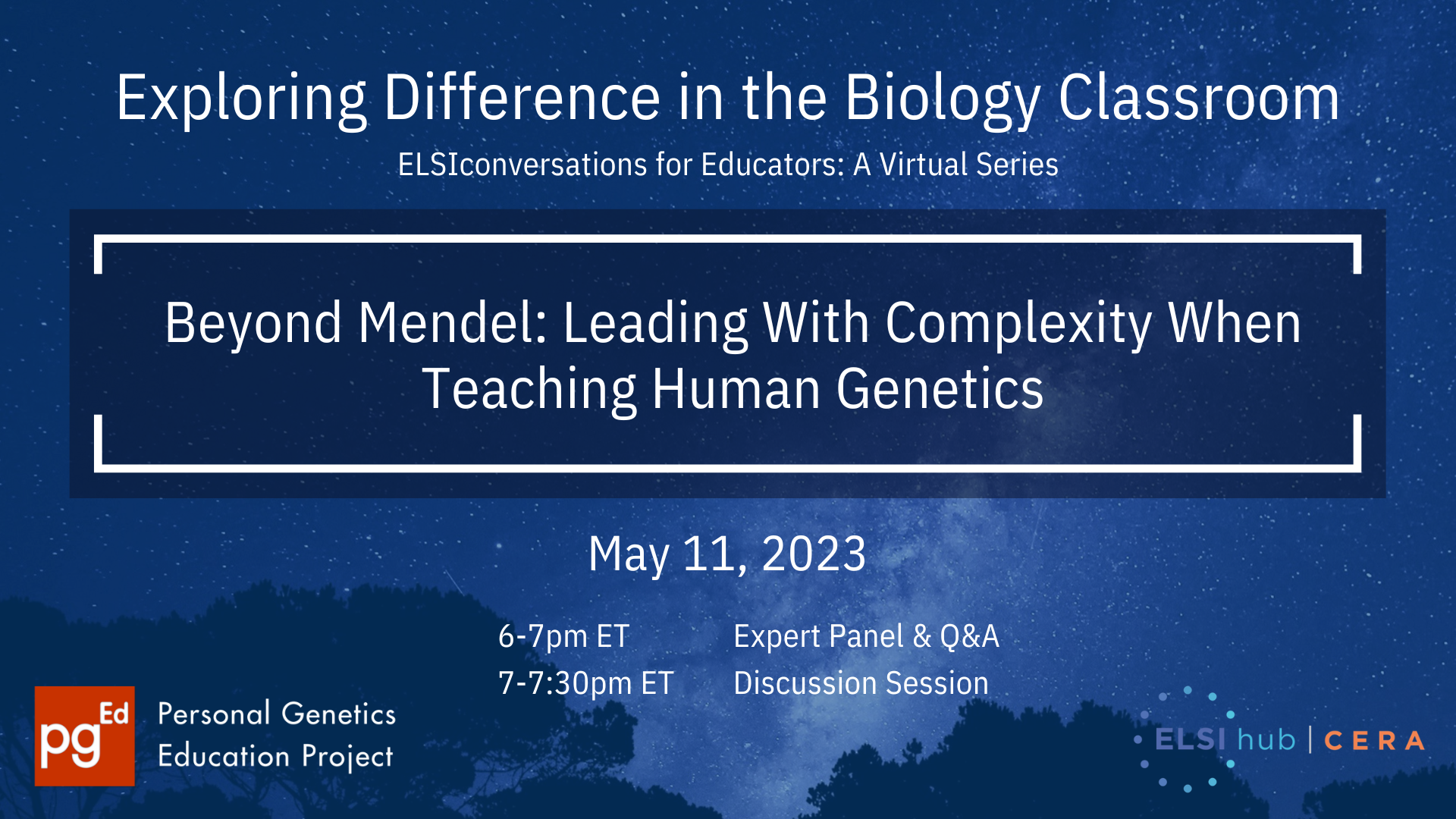
Teaching Mendelian patterns of inheritance is a useful way to introduce basic genetic concepts in the classroom. However, this framework can be unhelpful or even misleading if students do not first appreciate that most, if not all, traits in living organisms result from interactions among genes, and between genes and their environments. Providing this full picture is particularly important in classroom discussions about human genetics. Instructors must avoid reinforcing or creating misconceptions about genetics and health. For example, the treatment of racial or ethnic group identity as representing discrete biological groups can hinder rather than advance impactful approaches for genomic medicine.
This program is part of a webinar series titled Exploring Difference in the Biology Classroom that brought together educators and researchers for conversations about the ethical, legal, and social implications (ELSI) of genetics. The series was organized by Personal Genetics Education & Dialogue in partnership with the Center for ELSI Resources & Analysis.
View Our Terms of Use & Copyright Policy Statements.

Panelists

Shawneequa Callier, J.D., M.A. Bioethics, is an Associate Professor with tenure in the Department of Clinical Research and Leadership at the George Washington University (GW) School of Medicine and Health Sciences (SMHS). For over a decade, she has also served as a Special Volunteer at the Center for Research on Genomics and Global Health at the National Human Genome Research Institute, NIH. Prior to joining the GW faculty, Professor Callier completed a post-doctoral fellowship at the Center for Genetic Research Ethics and Law, an interdisciplinary center for excellence funded by the National Human Genome Research Institute and located in the Bioethics Department of Case Western Reserve University’s School of Medicine. Earlier in her career, Professor Callier practiced healthcare law as an attorney in Washington, D.C. She also interned at the World Health Organization and the Nuffield Council on Bioethics, examining international health research ethics policies and human genetics laws and guidelines. Read Shawneequa's full bio.

Dr. Eimear Kenny, PhD, is a Professor of Medicine and Genetics, and the Founding Director of the Institute for Genomic Health. She leads research at the interface of genomics, medicine, and computer science. She uses data science and massive-scale databases of genomic information to improve human health. Her research spans several different areas, including population and statistical genetics; machine-learning approaches for genomic discovery for rare and common diseases; genomic risk prediction for preventive health; clinical trials in genomic medicine; and digital app development for precision medicine. Her goal is to lead a new paradigm for genomic research embedded in health systems and to enable genomic medicine on a global scale. She is a scientific advisor to many initiatives in government, non-profit and industry arenas.