
Building Awareness, Respect, & Confidence through Genetics
From 2016 – 2021, PGED completed a school-based project, called ARC (Building Awareness, Respect, and Confidence through Genetics), through a five-year grant from the National Institutes of Health Science Education Partnership Award (SEPA) program. The aim of ARC was to (1) develop curricula on genetics and identity and (2) provide professional development that supports educators in bringing the topic of genetics to their classroom, regardless of what discipline they teach.
Curriculum on Genetics, Identity, & Respect for Diversity
As part of ARC, we have developed a series of lesson plans on genetics and identity with science, social science, and language arts teachers in mind. We are bringing our balanced and accessible approach to lesson plans that aim to get students thinking about hot topics in genetics.
ARC Team Resilience
In 2020, our travel was suspended due to COVID and we pivoted quickly to reinvent this programming online. The ARC team quickly organized and implemented 9 single-lesson workshops and two full online PDs (a virtual equivalent of our 3-day in-person workshops). In addition, we responded to invitations from former ARC teachers, SEPA colleagues, and PBS stations to provide additional PDs online.
Through online programs, we engaged 291 educators from 29 US states and abroad (including Canada, India, Spain, and Vietnam).
It has been our privilege to visit all these communities, meeting with teachers and working together to bring the topic of personal genetics to biology, social studies, and language arts classrooms and beyond.
Updated Lesson Plans
As part of ARC, our lesson plans have received regular updates to stay current. In particular, PGED has significantly revamped the following lesson plans to be more inclusive of diverse voices, more interdisciplinary, and up-to-date with the latest developments in the field.
Interdisciplinary Professional Development on the Road
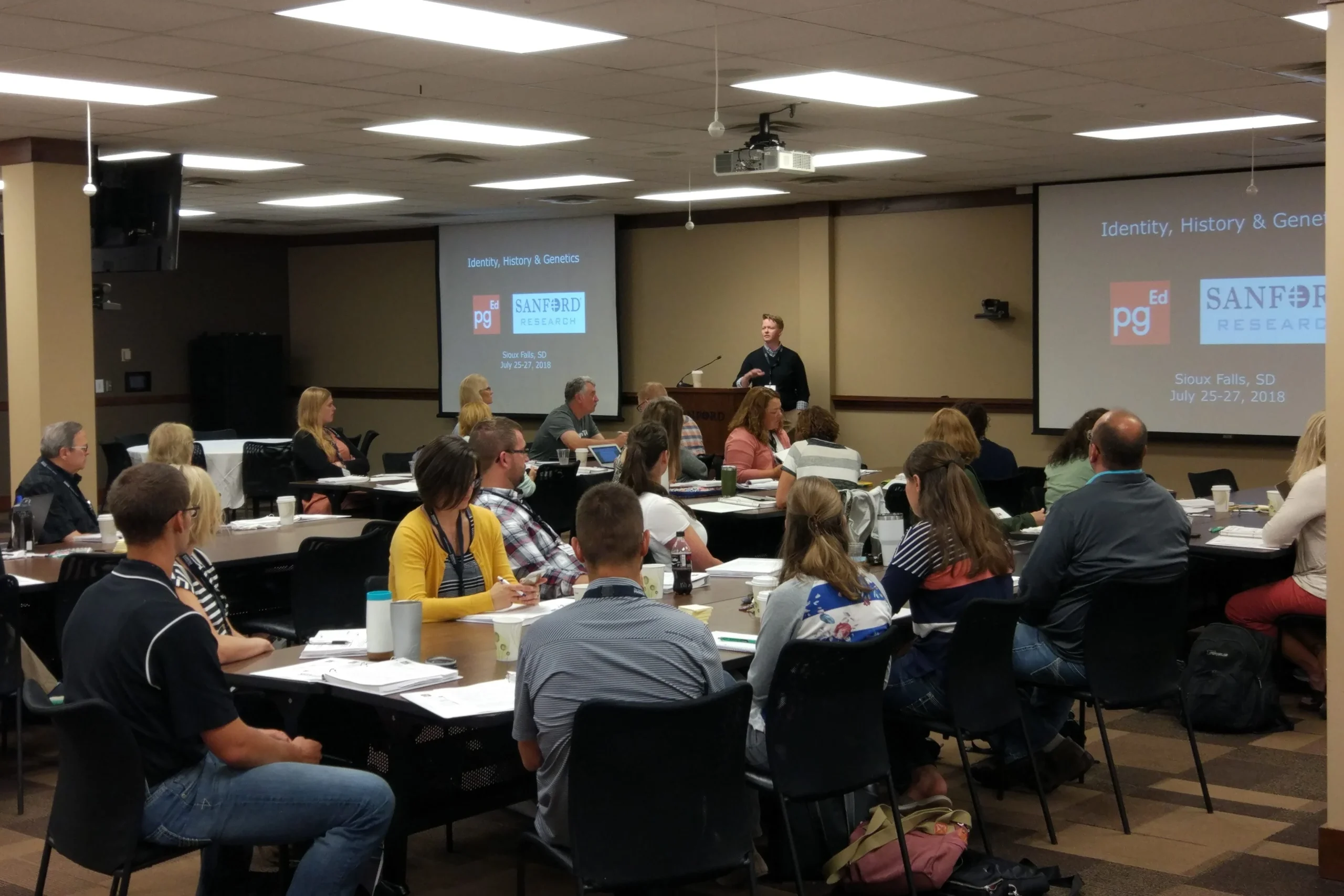
As part of ARC, we’ve organized a series of interdisciplinary professional development workshops. Over the past few years, we’ve held workshops in:
- Boston, Massachusetts (at Harvard Medical School)
- Brockton, Massachusetts (in partnership with Brockton High School)
- Sioux Falls, South Dakota (in partnership with Sanford Research and Harrisburg High School)
- Brunswick, Maine (in partnership with the SEPA team at Jackson Laboratory)
- Hartford, Connecticut (in partnership with the SEPA team at Jackson Laboratory)
- Kerrville, Texas (in partnership with the SEPA team at Texas A&M Health Science Center)
- Huntsville, Alabama (in partnership with the SEPA team at HudsonAlpha Institute for Biotechnology)
- Omaha, Nebraska (in partnership with the SEPA team at the University of Nebraska Medical Center)
- Milwaukee, Wisconsin (in partnership with the SEPA team at the Milwaukee School of Engineering)
Stories from Our Community
The ARC team has advanced the overarching goal of developing a model for empowering teachers to increase awareness and respectful dialogue about personal genetics in classrooms, schools, and communities. Overall, what has been most profound for us is the unique stories we’ve heard from our teachers – their insights from the frontlines in their classrooms, the interdisciplinary collaborations they’ve forged, and their commitment to ensuring that their students are having conversations about genetics, health, and society. Here are a few words from these teachers, who have become enthusiastic partners in helping to ensure an equitable and safe path forward as genetic technologies enter our world:
Informational Resources

Genetics, Ancestry, & Health (2018)

Sex, Gender, & Genetics (2019)
Distance Learning Resources
To support teachers transitioning to remote instruction, the ARC team recorded videos of 6 lesson presentations and developed a library of 13 short, student-facing lessons, called mini-lessons (all freely available online).


Introduction to Genetics and Medicine (2020)
Benefits for All?: Addressing Issues of Inclusion & Trust for Equitable Access to Precision Medicine (2020)
Identifying & Understanding Rare Genetic Conditions: Meet Tess Bigelow (2020)
Saving the Hawaiian Honeycreeper Birds (2020)
Privacy Protections for Genetic Information: Meet GINA (2020)
Ancestry and Identity in the Genomic Age (2020)
Direct-To-Consumer Testing in the Genomic Age (2020)
Genome Editing & Organ Transplants (2020)
Admixture Testing: How can your DNA provide insights into your ancestry? (2021)
When New Treatments Come with Big Hopes and a Big Price Tag (2020)
ACTN3: Can genetics tell me if I am going to be an Olympic sprinter? (2020)
With support from the Teaching the Genome Generation SEPA to The Jackson Laboratory
Mitochondrial Replacement Therapy – the science, benefits, and implications of a new reproductive genetic therapy (2020)
The Common Thread: DNA and Human Variation (2021)
This project is supported by the National Institute of General Medical Sciences, the National Institutes Of Health under Award Number R25GM129172. The content is solely the responsibility of the authors and does not necessarily represent the official views of the National Institutes of Health.